



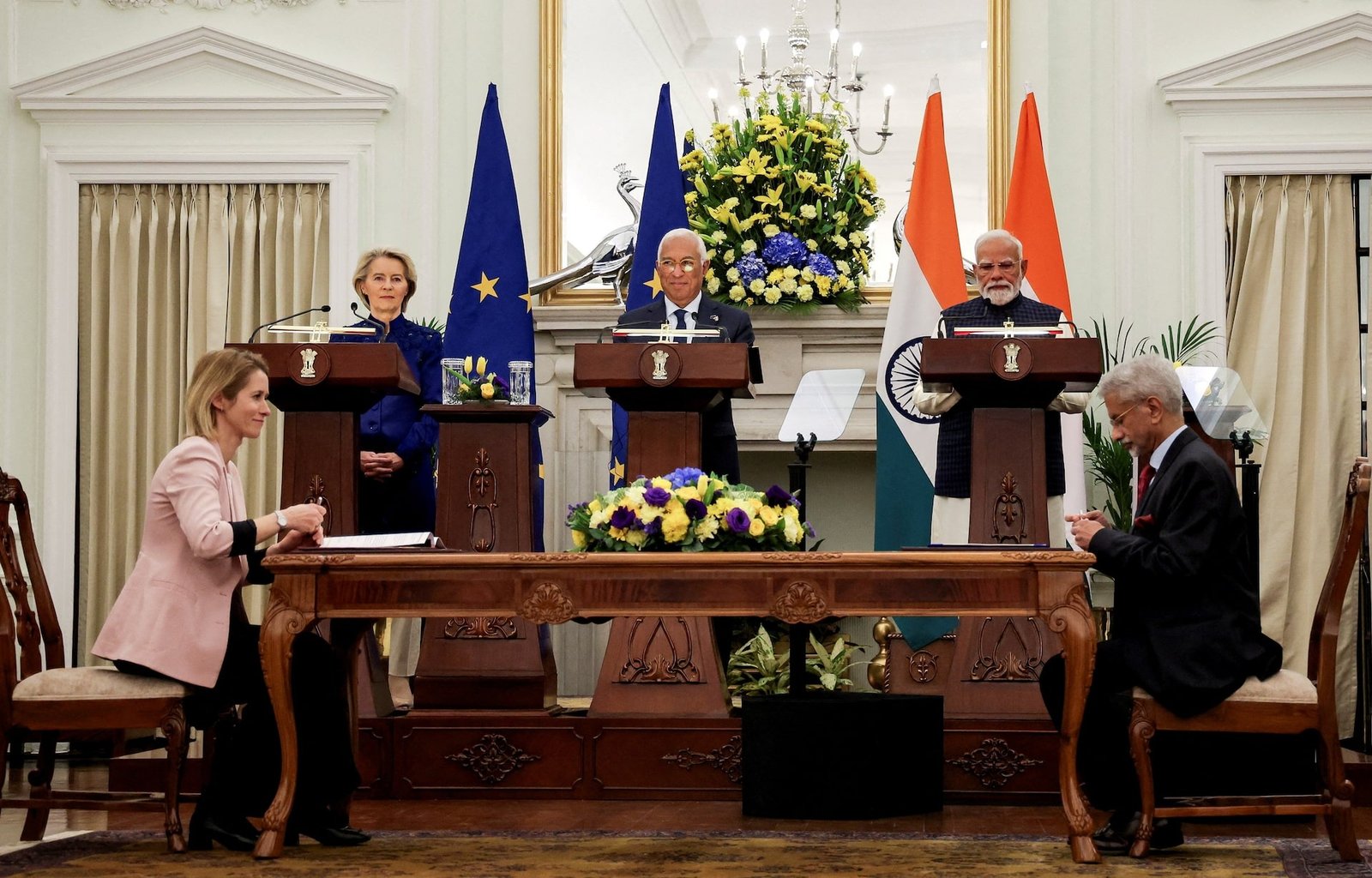
In a sharply worded critique, US Treasury Secretary Scott Bessent has accused European leaders of hypocrisy following the signing of a landmark EU-India Free Trade Agreement (FTA). Bessent argues that by deepening trade ties with India—a major buyer of Russian crude—Europe is indirectly financing the Russian war effort in Ukraine. He highlighted a “moral and strategic trade-off” where Europe prioritizes cheap energy and trade deals over the geopolitical imperative of ending the conflict. These remarks expose a deepening rift in the Western alliance regarding the enforcement of Russian sanctions and the management of global energy security.
Core Arguments from the Treasury Secretary
Scott Bessent’s critique focuses on what he describes as a “deep contradiction” in European foreign policy:
| Point of Contention | Bessent’s Stance |
| Indirect Funding | Claims Europe buys refined oil products from India that were originally sourced from sanctioned Russian crude. |
| Tariff Divergence | Noted that the US imposed a 25% tariff on India for Russian oil purchases, a move Europe refused to mirror. |
| Prioritization | Accuses the EU of putting “European trade ahead of the Ukrainian people” to secure the FTA. |
| Energy Security | Acknowledges Europe’s need for energy but labels the pursuit of “cheap energy” through these channels as a moral failure. |
Geopolitical Context: The EU-India Balancing Act
The signing of the EU-India pact is one of the most significant trade events of the mid-2020s. However, it sits at the center of a complex geopolitical triangle:
-
The US Position: Washington has taken a harder line, using tariffs to pressure neutral nations like India to distance themselves from Russian energy.
-
The European Position: Facing high domestic energy costs and industrial stagnation, the EU has prioritized economic stability and diversified trade partners to reduce reliance on both Russia and, to an extent, the US.
-
The Indian Position: India has consistently maintained that its energy purchases are driven by its own national interest and the need to provide affordable fuel to its 1.4 billion citizens.
Fact-Checking & Observations (2026)
-
Mark Carney Reference: The text mentions Mark Carney as the Prime Minister of Canada. As of early 2026, this reflects a significant shift in Canadian politics (succeeding Justin Trudeau), which explains the “rift” mentioned between Washington and Ottawa.
-
The “Refined Oil” Loophole: Bessent’s claim about Europe buying refined Russian oil from India is a documented economic reality known as the “laundering” of Russian oil, which has been a point of contention for several years.
-
US-EU Friction: These comments signal a move away from the “united front” seen in 2022-2023, as domestic economic pressures in the US and EU lead to more protectionist and divergent foreign policies.
Impact on Global Markets
-
Trade Tensions: Bessent’s remarks may lead to increased scrutiny of Indian exports to Europe.
-
Strategic Autonomy: The EU’s decision to proceed with the deal despite US pressure underscores Europe’s push for “strategic autonomy” in trade.