



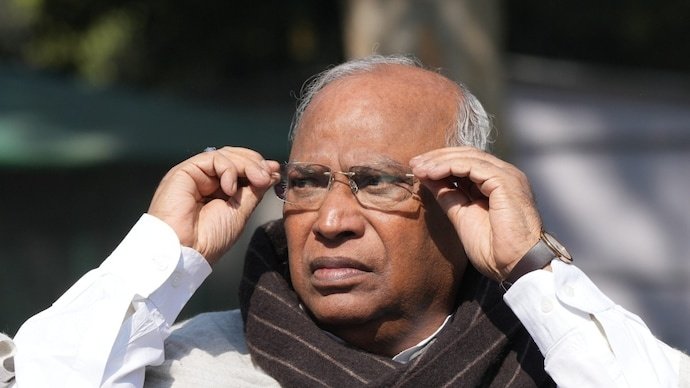
BENGALURU – Congress President Mallikarjun Kharge has sought to quiet intensifying rumors regarding a leadership change in Karnataka, asserting that there is no immediate plan to replace the incumbent Chief Minister. Speaking on the matter, Kharge indicated that while the party remains observant, “there is still time” before any such decision is considered.
The statement comes as the Congress government reaches a critical juncture, having surpassed the midpoint of its five-year term on November 20, 2025.
High-Level Decision-Making Process
Addressing the frequent speculation surrounding a power-sharing agreement or a rotating Chief Ministership between Siddaramaiah and D.K. Shivakumar, Kharge clarified the party’s internal protocol. He emphasized that leadership transitions are collective decisions involving the high command.
-
Current Status: Kharge noted that a Chief Minister is already firmly in place and functioning.
-
Collective Leadership: Decisions regarding any future shifts will be made jointly by Sonia Gandhi, Rahul Gandhi, and Kharge himself.
-
Timing: The party chief dismissed the urgency of the matter, suggesting the current focus remains on administration rather than transition.
Renewed Debate and Dalit Leadership
The leadership discussion was recently reignited by Karnataka Home Minister G. Parameshwara, who publicly voiced support for a Dalit Chief Minister. Parameshwara pointed to Kharge’s five decades of service as a benchmark of capability.
“He is a senior politician with more capability than many of his contemporaries who became Chief Ministers. I feel that if he becomes Chief Minister, it would give meaning to his 50 years of service,” Parameshwara remarked, adding that Kharge’s seniority would command undisputed respect within the party.
Eyes on Upcoming Election Results
The political climate in Karnataka is expected to remain charged as the state awaits the results of by-elections in the Bagalkot and Davanagere South assembly segments on May 4. These results, alongside assembly election outcomes from four other states and one Union Territory, are widely seen as potential catalysts for the next phase of internal party discussions.
For now, the Congress leadership appears intent on maintaining stability, even as senior state leaders continue to deliberate on the long-term representation and composition of the state’s top office.