



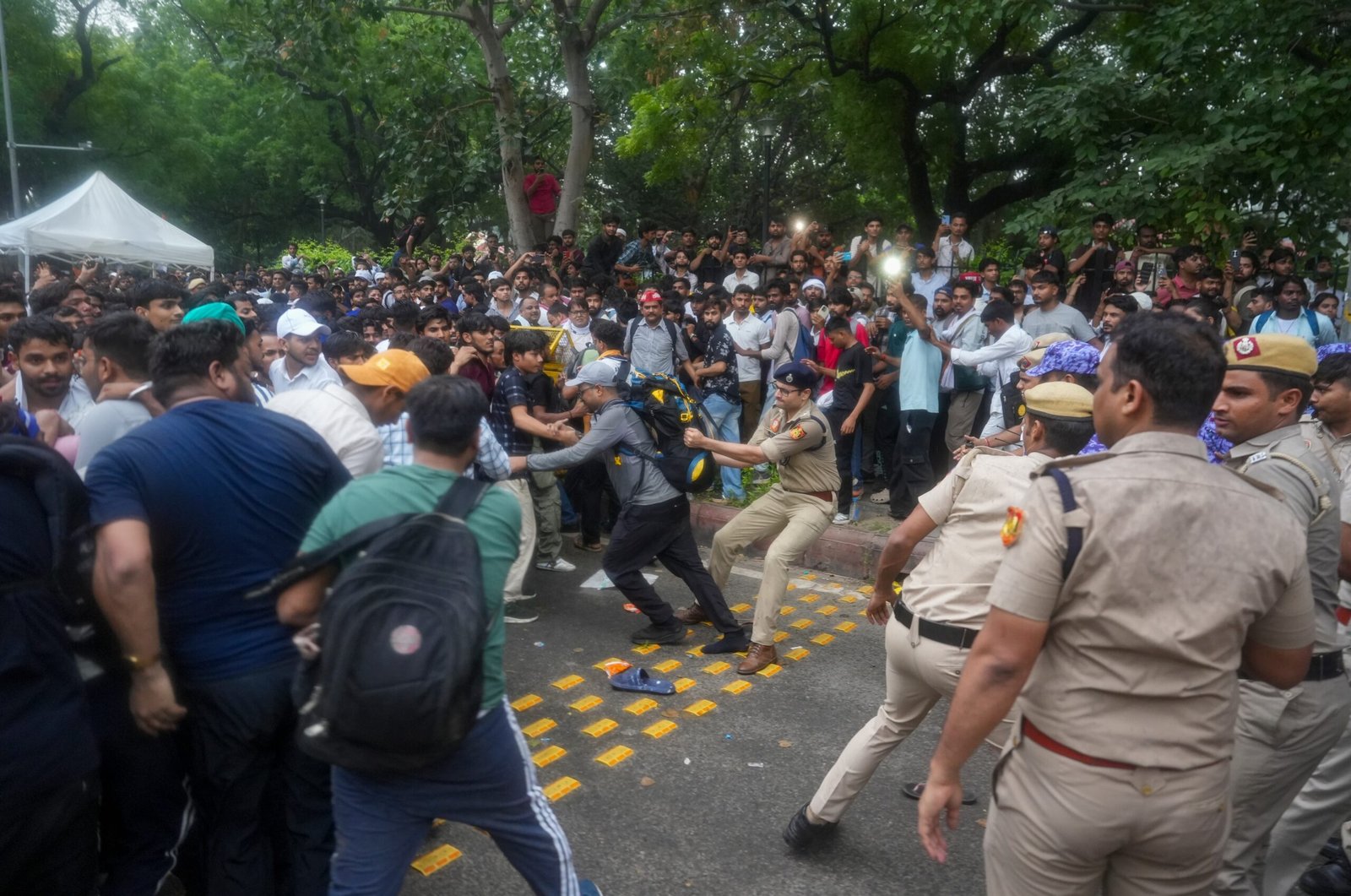
NEW DELHI — Chaos erupted in the heart of the national capital on Monday as Delhi Police deployed lathi-charges and enforced mass security restrictions to stop a massive, youth-led “Chalo Sansad” (March to Parliament) rally organized by the digital-first Cockroach Janta Party (CJP).
Timed with the commencement of the Parliamentary Monsoon Session, the demonstration aimed to highlight systemic grievances concerning competitive exam irregularities, specifically targeting the recent NEET controversy.
Security Containment and Police Action
Despite explicit prohibitory orders issued by the Delhi Police under Section 163 of the Bharatiya Nagarik Suraksha Sanhita (BNSS), thousands of predominantly young protesters converged on the Jantar Mantar area:
-
Force Deployment: As crowd limits breached designated boundaries in an attempt to march towards Parliament House, police personnel resorted to batons and sticks to disperse the gathering.
-
Digital and Grid Lockdowns: To limit coordination among assembling protesters, mobile internet access was selectively deactivated across sections of Central Delhi.
-
The CJP Directive: Amid escalating clashes, the CJP leadership released an official advisory via social channels urging its base to maintain discipline: “Even if you’ve been stopped at certain points, remain calm and maintain peace.”
Mass Disruptions Across the Capital Transit Grid
The sudden security enforcement and preventative lockdowns led to acute logistical disruptions for daily commuters across New Delhi’s transit networks:
-
Metro Station Closures: Security wings directed the immediate closure of entry and exit gates across five major transit hubs: Rajiv Chowk, Janpath, Patel Chowk, Central Secretariat, and Seva Teerth.
-
Commuter Backlog: Stranded passengers flooded terminal points, particularly at Rajiv Chowk—one of the city’s primary interchange zones—as commuters were forced to adapt to unexpected perimeter detours.
The Meteoric Rise of the Cockroach Janta Party (CJP)
The sudden political mobilization highlights the rapid conversion of digital satire into active grassroots pressure:
-
Satirical Origins: The CJP was originally conceived in May 2026 by digital strategist Abhijeet Dipke as a satirical response to controversial remarks made by Chief Justice of India Surya Kant referencing “parasites” and “cockroaches.” The platform quickly gathered millions of digital followers, drawing cross-ideological backing from activists and opposition figures.
-
The Transition to Activism: Dipke, 30, returned to India in June from the United States to personally spearhead an anti-paper-leak campaign, framing educational infrastructure reforms as the group’s central agenda.
Hunger Strike Updates: Sonam Wangchuk Hospitalized
The movement previously intersected with prominent environmentalist and educational reformer Sonam Wangchuk, whose ongoing fast has added significant weight to the protest footprint:
-
Medical Evacuation: Wangchuk, 59, was forcibly moved to a hospital facility by police authorities on Saturday following 18 consecutive days of an indefinite hunger strike at Jantar Mantar.
-
The Hospital Manifesto: In a handwritten note released from his medical bay on Monday, Wangchuk declared that his fast would only terminate if the government explicitly accepts structural accountability for paper leaks, or if parliamentary representatives formally pledge to floor the educational crisis during the Monsoon Session.