



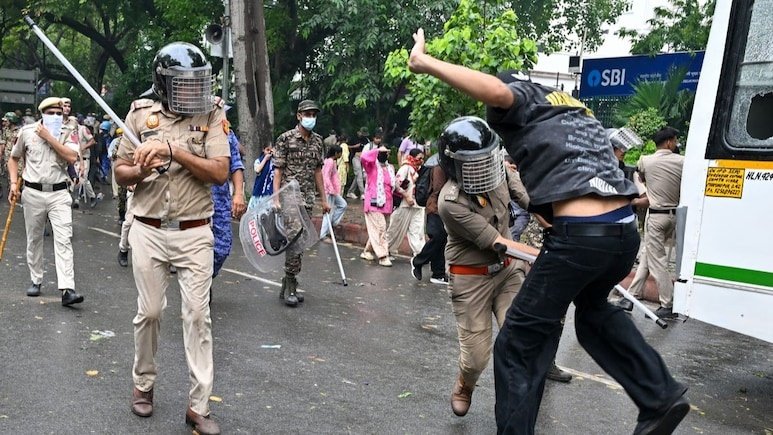
New Delhi | July 27, 2026
In a stern reminder to law enforcement agencies, the Supreme Court today reaffirmed that the right to peaceful, lawful protest is an “absolutely guaranteed” constitutional protection, observing that the mere occurrence of an agitation cannot justify police resorting to lathicharges or heavy-handed force.
The top court’s observations came during a hearing on a batch of petitions seeking an independent probe into the July 20 police action at Jantar Mantar, where a student-led Sansad Chalo march over competitive exam paper leaks was met with tear gas, baton charges, and severe police intervention.
Apex Court Call for Accountability and Evidence Preservation
Addressing the bench, the top court emphasized that state apparatus must distinguish between unlawful violence and constitutionally protected assembly.
Beyond examining police conduct during the march, the apex court agreed to consider related pleas, including allegations concerning police personnel injured during the agitation, ensuring a comprehensive assessment of the violence.
The petitioners have urged the court to issue directions for:
-
An independent investigation into the precise sequence of events and force deployment on July 20.
-
Immediate preservation of key electronic evidence, including local CCTV camera feeds, police body-cam footage, and media recordings.
-
Direct financial compensation for students who sustained injuries during the crackdown.
Political Flashpoint and Allegations of High-Handedness
The July 20 police crackdown at Jantar Mantar sparked widespread political backlash, escalating student demonstrations from the capital to multiple states across the country. Opposition parties repeatedly stalled parliamentary proceedings last week, demanding accountability and political resignations over the handling of both the exam leaks and the subsequent student protests.
Leader of the Opposition Rahul Gandhi stepped up his criticism today, accusing law enforcement of employing disproportionate measures against student demonstrators. Speaking to reporters after visiting injured students in the hospital, Gandhi alleged that security personnel used pellet guns and extreme force to quell peaceful demonstrations—claims that the Delhi Police have categorically denied.
Unrest Triggers Political Shift
The judicial scrutiny follows weeks of heightened tension surrounding national competitive examinations. A 36-day student movement formally concluded over the weekend after the administration agreed to key student demands, culminating in the resignation of former Education Minister Dharmendra Pradhan.
With the Supreme Court now stepping in to review the law enforcement response, the focus shifts toward establishing clear legal parameters for managing peaceful civil demonstrations while securing accountability for injuries sustained during the crackdown.