



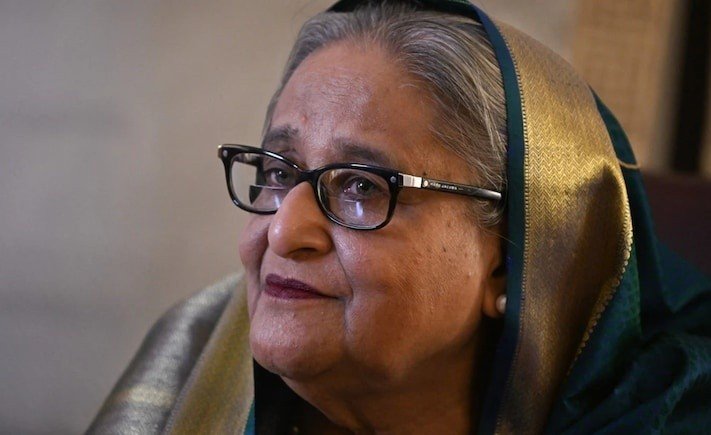
NEW DELHI — Breaking a two-year media silence from her exile in India, deposed Bangladeshi Prime Minister Sheikh Hasina declared on Wednesday her intention to return to Dhaka in December, framing her impending journey as a high-stakes mission to restore democracy, secularism, and stability to her home country.
Speaking in an audio-only virtual press conference hosted at the Foreign Correspondents’ Club in New Delhi—her first direct media interaction since fleeing Bangladesh on August 5, 2024—the Awami League leader addressed her precarious legal status and potential return with acute starkness.
“I know they may put me in jail or kill me,” Hasina said, addressing journalists over the broadcast. “Whatever fate awaits me, I will return to my people. My life moved beyond calculations of personal safety long ago.”
Escalating Diplomatic Strain Between Dhaka and New Delhi
The high-profile virtual event triggered an immediate diplomatic backlash from Dhaka. The Bangladesh Ministry of Foreign Affairs issued a sharp statement expressing outrage that Indian authorities allowed Hasina to host the conference on Indian soil, characterizing the platform as an “affront to the sovereignty of Bangladesh.”
Relations between the neighboring nations have grown increasingly taut since a special tribunal in Dhaka sentenced Hasina to death in absentia last November for alleged crimes against humanity tied to the violent crackdown on student-led protests in July and August 2024. Dhaka reiterated that its formal requests for her extradition under the 2013 bilateral treaty have so far yielded no response from New Delhi.
“Regrettably, Bangladesh’s repeated requests to the Government of India for returning convicted criminal Hasina… [have] not yet elicited a response,” the ministry stated, emphasizing that bilateral relations must rest on non-interference in internal affairs.
For her part, Hasina reaffirmed her view of India as a “great friend” that historically supported her country during crises, while dismissing any possibility of back-channel negotiations with the current Bangladesh Nationalist Party (BNP)-led government to secure her safe passage.
A Broad Agenda and Allegations of Manipulation
During the six-minute read-time presentation, Hasina laid out a sweeping set of demands aimed at unravelling the political framework established after her exit. She called for the immediate lifting of the official ban on the Awami League, the release of political prisoners, the restoration of free speech, and guarantees for judicial independence.
Reflecting on the civil unrest that precipitated her fall from power, Hasina disputed the characterization of the mid-2024 uprising as a purely spontaneous youth movement. She alleged that organized factions covertly directed the unrest to bypass democratic elections.
“It was not simply a spontaneous students’ protest,” Hasina claimed. “There was no visible or responsible leadership. Instructions were given invisibly… to create a path to power outside the ballot box.”
Addressing Bangladeshi youth directly, she urged them to protest injustice while warning against being used as “an instrument of destruction,” framing the current state of the nation as one dominated by pervasive fear.
AL Leadership Warns of Regional Instability
Joining the conference, senior Awami League leaders and Hasina’s son, Sajeeb Wazed Joy, painted a grim picture of Bangladesh’s internal security landscape under the caretaker political arrangement. Joy asserted that political violence has been normalized since August 2024, warning that the country faces severe law-and-order collapse.
“What should concern New Delhi most is that Bangladesh has become another Pakistan on India’s eastern border,” Joy claimed, arguing that a destabilized Bangladesh poses significant spillover risks for South Asian regional security, trade, and maritime stability in the Bay of Bengal.
Hasina insisted her impending return is not driven by personal ambitions for power, but rather a desire for national reconciliation and economic recovery. However, with Dhaka actively pursuing her extradition to execute the special tribunal’s capital sentence, her pledged December return sets up an unprecedented showdown between the former leader and Bangladesh’s current governing authorities.