



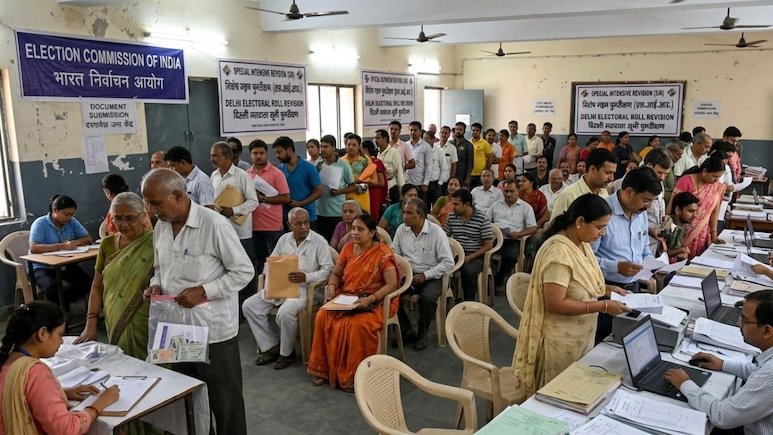
NEW DELHI — The Supreme Court of India questioned the Election Commission of India (ECI) regarding procedural irregularities in the ongoing Special Intensive Revision (SIR) of electoral rolls in Delhi, ruling that statutory voter registration forms cannot be modified or misused to re-enroll existing voters.
A bench comprising Chief Justice of India Surya Kant, Justice Joymalya Bagchi, and Justice V. Mohana instructed the electoral body to remove strict submission deadlines and develop simplified procedures for voters whose names were omitted from current rolls.
Key Takeaways
-
Statutory Form Protection: The apex court ruled that the Election Commission lacks authority to alter statutory Forms 6, 7, and 8, emphasizing that Form 6 is reserved exclusively for new voter registrations.
-
Removal of Cut-Off Deadlines: The bench directed the ECI to drop its October 30 cut-off date for voter re-enrollment, pointing out that no immediate municipal or assembly elections are scheduled in Delhi.
-
Proactive Outreach Mandate: The court urged the commission to actively reach out to unlisted citizens rather than placing the entire administrative burden on voters to re-establish eligibility.
-
Scale of Disfranchisement Concerns: Petitions highlighted that out of 1.45 crore registered voters in Delhi, enumeration forms were not received from approximately 47 lakh individuals during the SIR drive.
Key Legal Arguments and Data Discrepancies
The hearing addressed petitions filed by transparency activists Anjali Bhardwaj and Amrita Johri regarding potential voter exclusion resulting from procedural classification errors:
-
Misclassification of Existing Voters: Senior advocate Prashant Bhushan argued that requiring existing voters to fill Form 6 forces them to falsely declare they were never previously enrolled. Form 8 remains the appropriate format for updating residential details.
-
Breakdown of Unmapped Voters: Out of 47 lakh uncollected enumeration forms, the ECI classified approximately 31.59 lakh citizens as permanently shifted, 11 lakh as missing or untraceable, and 2 lakh as deceased.
-
Distribution Issues: Petitioners demonstrated that large numbers of citizens failed to submit forms due to non-receipt during door-to-door enumeration drives or local relocation within the capital.
Directives for Administrative Relief
The Supreme Court asked the Election Commission to adopt pragmatic measures to safeguard voting rights across the national capital territory:
-
Tailored Solutions: The court instructed officials to establish a distinct, simplified verification pathway for previously registered voters rather than treating them as first-time applicants.
-
Deadline Flexibility: The Election Commission indicated its willingness to extend application submission windows and continue processing Form 6 and Form 8 filings without arbitrary cutoff constraints.