



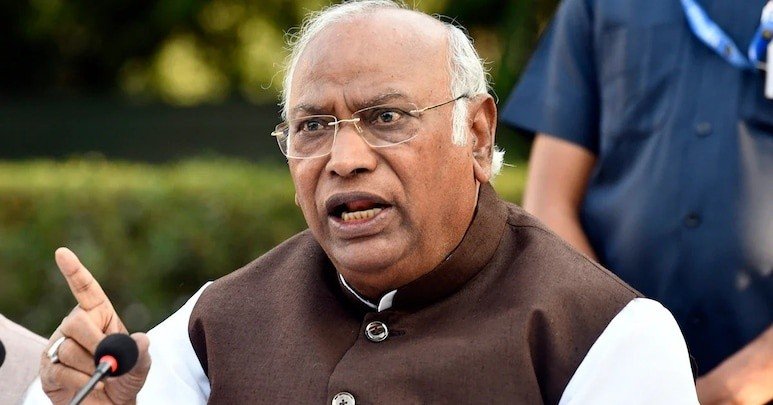
NEW DELHI — The Congress party has issued a sharp “summary response” to the Election Commission of India (ECI), defending party chief Mallikarjun Kharge against a show-cause notice regarding his recent “terrorist” remark. The opposition party has slammed the move as a violation of natural justice, claiming the notice “smacks of ulterior motives.”
Congress General Secretary Jairam Ramesh has requested a one-week extension to file a detailed legal response, citing the Congress President’s hectic national campaign schedule.
The “Terrorist” Remark Controversy
The ECI’s notice follows a speech by Kharge in Chennai where he initially used the word “terrorist” while criticizing the AIADMK-BJP alliance. Kharge immediately clarified his stance in the same briefing:
-
The Clarification: Kharge stated he meant the PM is “terrorising” the democratic fabric and political parties through the misuse of central agencies like the ED, IT, and CBI.
-
Congress Defense: Ramesh argued that the ECI relied on a “quote taken out of context” by complainants and failed to acknowledge the instant clarification already in the public domain.
Allegations of ECI Administrative “Lapses”
In a letter to the Chief Election Commissioner, Jairam Ramesh highlighted several procedural inconsistencies:
-
Conflicting Notices: The party reportedly received two different notices under the same number, signed by different officials.
-
Complainant Discrepancy: One notice named TMC’s Derek O’Brien as the complainant, while another version uploaded to the ECI website mysteriously dropped the name.
-
Short Deadline: The Congress criticized the ECI for giving a mere 24-hour window to respond during a peak election phase.
The Counter-Attack
While responding to the notice, the Congress also demanded ECI action on two other fronts:
-
PM Modi’s Speech: Alleged violation of the Model Code of Conduct (MCC) for attacking the Congress by name and accusing it of “foeticide” during an address to the nation.
-
Amit Shah’s Campaign Promises: Alleged that promises of direct cash transfers to women and youth (e.g., ₹3,000/month) constitute a “quid pro quo” and bribery under the Representation of the People Act, 1951.
| Key Fact | Summary |
| Notice Date | April 22, 2026 |
| Context | Phase 1 of polling in Tamil Nadu & West Bengal |
| Main Charge | Violation of MCC regarding personal remarks against the PM |
| Congress Stance | Categorical denial of any law or code violation |
The Congress has requested a hearing with a senior delegation to present their full legal rebuttal once the requested one-week extension is granted.