



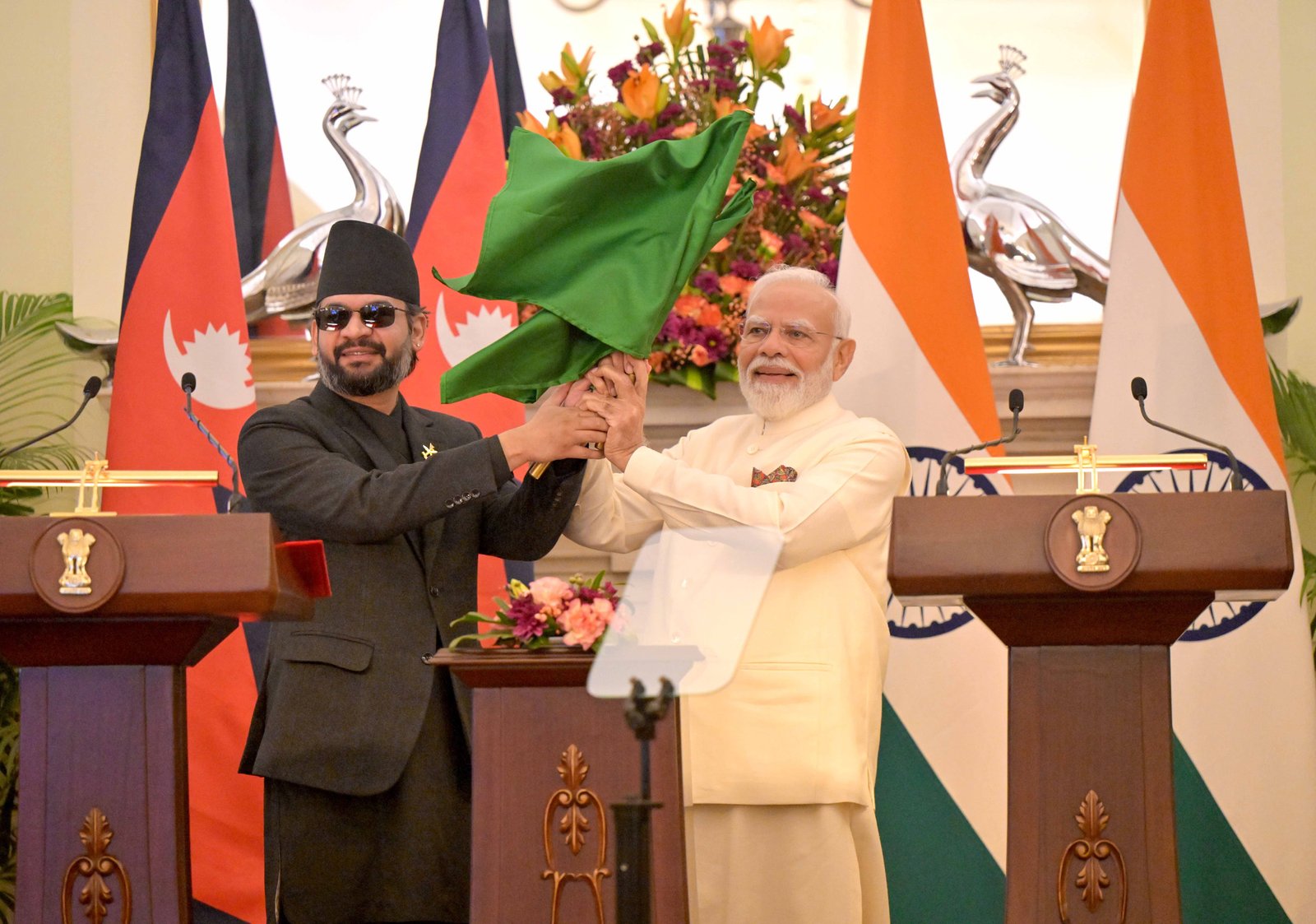
NEW DELHI — Nepalese Prime Minister Balendra Shah concluded a two-day State visit to India on Monday, November 23, 2026, following talks with Prime Minister Narendra Modi that yielded a ₹15,000 crore financial package, a “Viksit Bharat and Samunnat Nepal” Joint Vision, and several cross-border rail, port, energy, and infrastructure initiatives.
Visiting India for the first time since taking office at Modi’s invitation from November 22 to 23, Shah received a ceremonial welcome at Rashtrapati Bhavan, paid tribute to Mahatma Gandhi at Rajghat, met President Droupadi Murmu and External Affairs Minister S. Jaishankar, and held bilateral discussions and a luncheon with Modi. Shah thanked India for relief and technical support following the Rasuwa-Bhotekoshi floods and formally invited Modi to visit Nepal, which Modi accepted with dates to be set through diplomatic channels.
Assistance Package, Joint Vision, and Campus Plan
Modi reaffirmed India’s commitment to Nepal’s development and announced ₹15,000 crore (NPR 24,000 crore) in assistance, with project details and modalities to be finalized through mutual consultations:
-
Grant and Credit Line: The package provides ₹3,500 crore (NPR 5,600 crore) in grant funding for post-disaster recovery and new infrastructure, alongside an ₹11,500 crore (NPR 18,400 crore) Rupee-denominated Line of Credit for energy projects.
-
Development and Institutional Initiatives: Both leaders reviewed ongoing High Impact Community Development Projects (HICDPs) and progress on Nepal’s National Police Academy built with Indian support, while welcoming a grant-backed Agro-Industrial Park in Chitwan.
-
Joint Vision and Education Ties: The two sides adopted a Joint Vision for “Viksit Bharat and Samunnat Nepal” covering economic and development ties, connectivity, energy, water resources, people-to-people exchanges, climate resilience, disaster management, sports, start-ups, digital services, space, and innovation. India also agreed to set up an offshore IIT campus in Nepal and facilitate easier banking and telecom access for residents of one country living in the other.
Rail, Aviation, Ports, and Border Links
Several initiatives were announced to strengthen physical connectivity and transit trade:
-
Rail Corridors: Modi and Shah flagged off the Sarayu-Kamala Express between Ayodhya and Janakpur to improve connectivity and religious tourism along the Ramayana Circuit, and agreed to explore links for Buddhist and Shiv-Shakti circuits. They also announced completion of the Field Location Survey for the proposed Raxaul–Kathmandu electrified broad-gauge railway and agreed to collaborate on Nepal’s East-West Railway.
-
Air Route and Sea Ports: Both sides agreed to make the unidirectional B345 Kathmandu–Bhairahawa–Lucknow air route bidirectional following technical consultations. India also opened a transit trade avenue for Nepal via Deendayal Port in Kandla, with access to Paradip Port planned once supporting infrastructure is established.
-
Check Posts, Bridges, and Boundary Work: The leaders virtually laid the foundation stone for a new Integrated Check Post (ICP) at Banbasa, reviewed progress on ICPs at Bhairahawa, Sunauli, and Dodhara-Chandani, and inaugurated a motorable bridge linking Dharchula and Darchula. They also noted progress on boundary pillar upkeep and directed Foreign Secretaries to address remaining boundary issues.
Petroleum, Hydropower, and Signed MoUs
Energy cooperation expanded alongside eight bilateral memorandums of understanding:
-
Fuel and Power Projects: The leaders dedicated Phase II of the Motihari–Amlekhgunj petroleum pipeline, virtually laid the foundation stone for a petroleum terminal at Jhapa, urged early commencement of work on the Siliguri–Jhapa pipeline, and agreed to explore gas pipeline cooperation. They also virtually laid the foundation stone for the 669 MW Lower Arun Hydro-Electric Project, noted progress on joint ventures for high-capacity transmission lines between Inaruwa and New Purnea and between Dododhara and Bareilly, and called for faster work on Detailed Project Reports for the Pancheshwar, Saptakoshi, and Sunkoshi multipurpose projects.
-
Eight MoUs Exchanged: The agreements cover forensic sciences and policing (National Forensic Sciences University with Nepal Police’s Crime Investigation Department, and Rashtriya Raksha University with Nepal’s National Police Academy); civil service capacity building (National Centre for Good Governance with Nepal Administrative Staff College); Ayurveda and traditional medicine; satellite communications (ISRO with Nepal’s Ministry of Information and Communication); sustainable urban development; health and medicine; and livestock and fisheries development.