



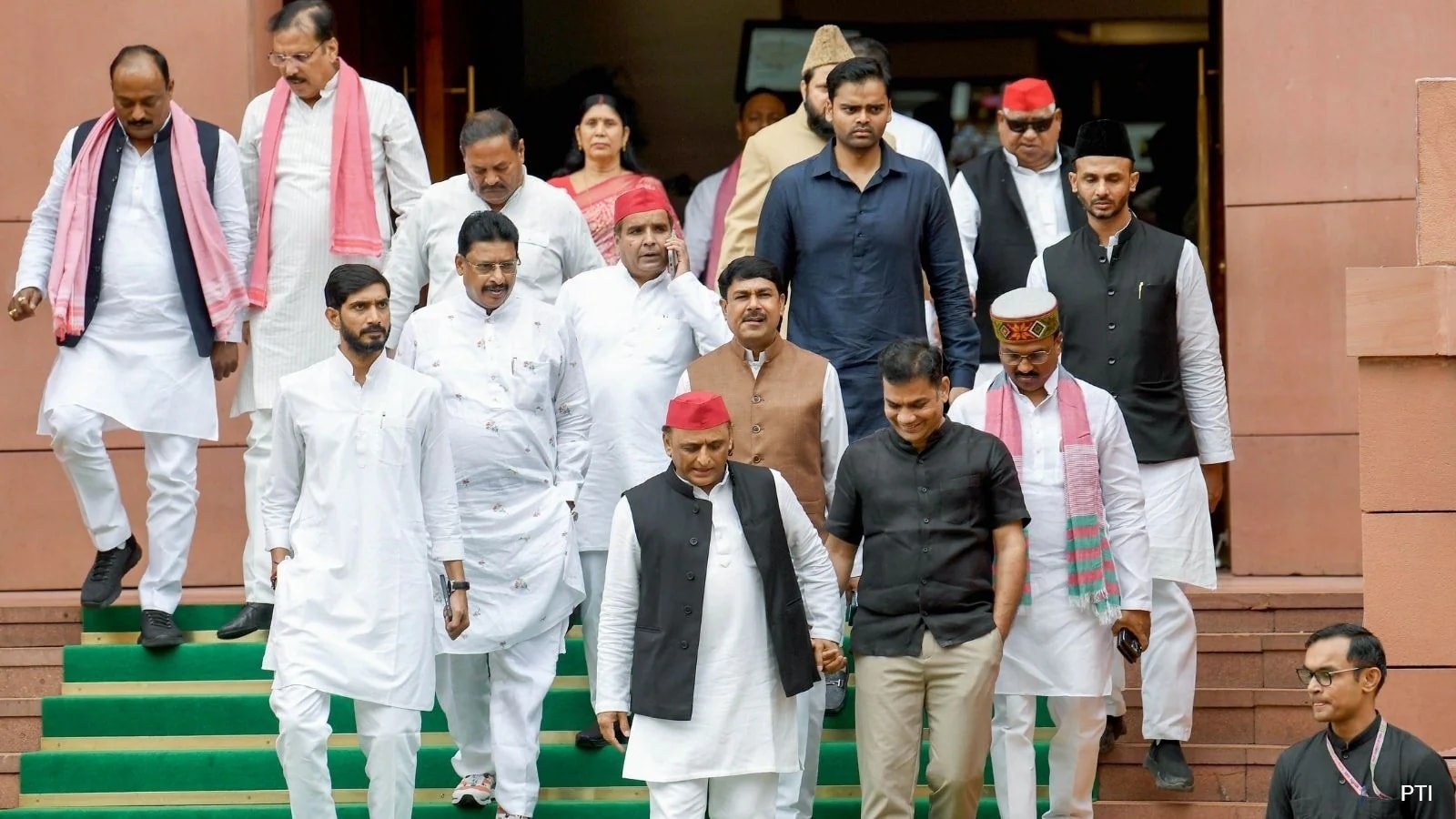
NEW DELHI — Marking a significant move in the lead-up to the 2027 Uttar Pradesh Assembly elections, Samajwadi Party (SP) chief Akhilesh Yadav met with senior Congress leaders Rahul Gandhi and Priyanka Gandhi in Parliament on the opening day of the Monsoon Session.
The hour-long discussion, held in the office of the Leader of the Opposition in the Lok Sabha, signifies the formal initiation of high-level talks between the two core INDIA bloc allies to forge a unified strategy against the ruling Bharatiya Janata Party (BJP).
Tactical Deliberations and Internal Demands
While the leaders officially framed the interaction as a routine courtesy meeting following house adjournments, political observers note that seat-sharing calculations and alliance friction dominated the agenda:
-
Competing Claims: State-level Congress leaders, including newly appointed UP in-charge Rajendra Pal Gautam and Saharanpur MP Imran Masood, have publicly called for an equal or substantial share of seats (claiming up to 200 out of 403 seats). However, ground realities suggest the Congress central leadership is aiming for roughly 100 seats in key strike zones.
-
The Samajwadi Party Stance: Insiders indicate the SP is calculating a lower allocation of around 60 to 80 seats for the Congress. Akhilesh Yadav has reportedly maintained that candidate winnability and booth-level organizational strength—rather than fixed quotas—must dictate seat distribution.
-
Historical Precedents: In the 2017 assembly polls, the SP allocated 105 seats to the Congress, but the alliance secured limited success. SP leaders contend that circumstances have changed, pointing to their dominant performance in the 2024 Lok Sabha elections where the SP won 37 seats and the Congress won 6.
Electoral Arithmetic: The PDA and Dalit Outreach
A central pillar of the meeting centered on preserving and expanding the social coalition—termed the PDA (Pichhda, Dalit, Alpsankhyak)—that yielded 43 out of 80 Lok Sabha seats for the alliance in 2024:
-
Dalit Voter Consolidation: The Congress argues that allocating a significant portion of seats to its candidates in high-probability belts is crucial to retaining Dalit voter confidence.
-
Grassroots Alignment: SP leadership has requested the Congress to submit a detailed list of potential candidates to assess ground viability, seeking to prevent public friction among state-level workers and ensure a unified campaign.