



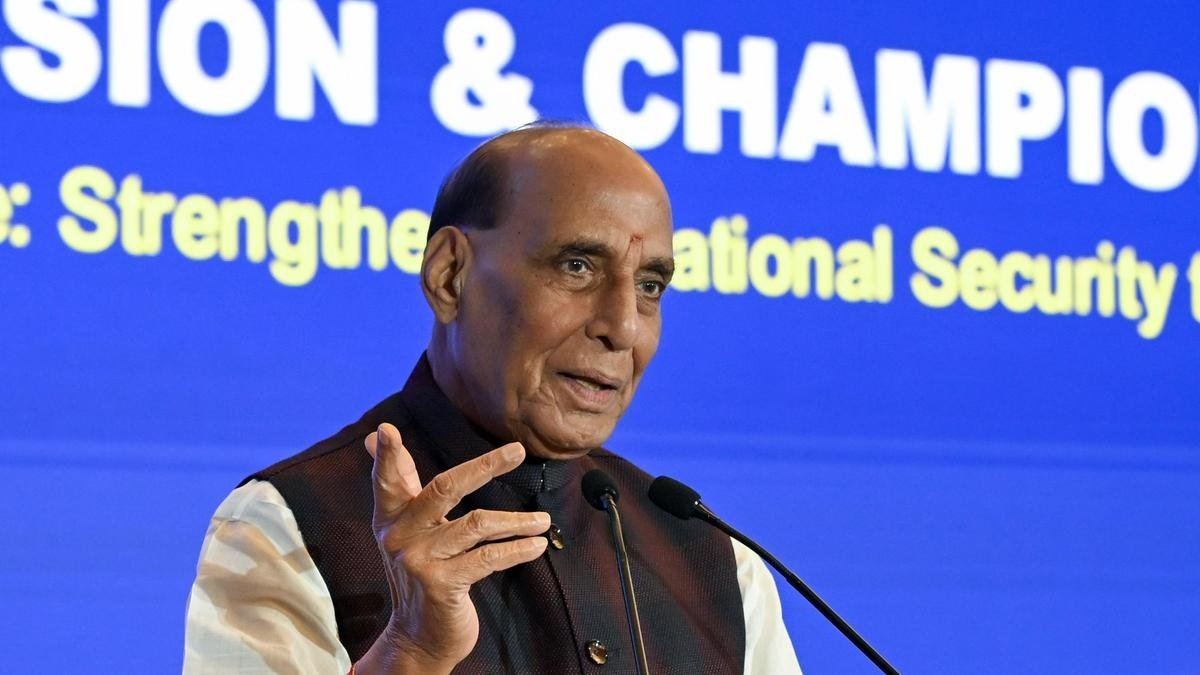
NEW DELHI — Characterizing the organization as an enduring anchor of national identity, Defence Minister Rajnath Singh described the Rashtriya Swayamsevak Sangh (RSS) as a “civilizational force that requires no institutional validation or certification.”
The Defence Minister made the remarks at Uprashtrapati Bhavan while officially releasing the book RSS@100: A Century of Service, Unity & Sacrifice, co-authored by Shyam Jaju and Anupam Trivedi. The high-profile literary launch was attended by Vice President CP Radhakrishnan, Delhi Assembly Speaker Vijender Gupta, and various senior cultural dignitaries.
Constitutional Mandates and Civilizational Metaphors
Addressing recent political critiques from opposition leaders questioning the legal registration status of the RSS, the Defence Minister dismissed the scrutiny as fundamentally redundant:
-
The Metaphorical Defense: Singh stated that trying to regulate or certify the organization’s ethos is unnecessary. “A mother’s love requires no license, a Guru’s values do not depend on a government seal, and the sun requires no registration to radiate light. Similarly, the RSS is a civilizational force,” Singh asserted.
-
Constitutional Validity: He emphasized that under the Constitution of India, every citizen possesses the fundamental right to form associations, making politically motivated questions about its registration mathematically and legally irrelevant.
-
Organizational Cohesion: The Defence Minister highlighted that the RSS stands as perhaps the only voluntary collective globally to operate continuously on such a massive scale for an entire century without ever suffering an internal split—a feat he attributed to a core philosophy of absolute indifference to personal fame.
Historical Interventions and National Integration
The address focused heavily on chronicling the structural role played by RSS volunteers in defending India’s sovereign borders and democratic frameworks over its 100-year history:
-
Territorial Milestones: Singh reminded the audience of critical historical flashpoints, noting that in 1947, MS Golwalkar was instrumental in persuading Maharaja Hari Singh to sign Kashmir’s accession to India. He also cited the active, frontline sacrifices of volunteers during the liberation of Dadra & Nagar Haveli in 1954 and the subsequent liberation of Goa.
-
Guardians of Democracy: The Defence Minister credited the RSS with acting as a key shield for civil liberties, pointing to its extensive underground resistance and leadership during the 1975 Emergency to restore the Constitution and safeguard free speech.
The Centenary Vision: The ‘Panch Pran’ Roadmap
As the organization approaches its official centenary milestone since its founding by Dr. Keshav Baliram Hedgewar in 1925, the leadership has rejected purely celebratory events in favor of systemic self-reflection:
-
The Five Pledges: The RSS has marked its century of service by adopting the Panch Pran (Five Pledges), aimed at building a value-driven, self-reliant, environmentally conscious society aware of its civic duties.
-
Socio-Economic Engine: Singh concluded that the small seed planted in 1925 has expanded into the world’s largest, completely financially self-reliant voluntary organization. He added that the newly formulated Panch Pran will effectively serve as the foundational pillars for a fully developed India.