



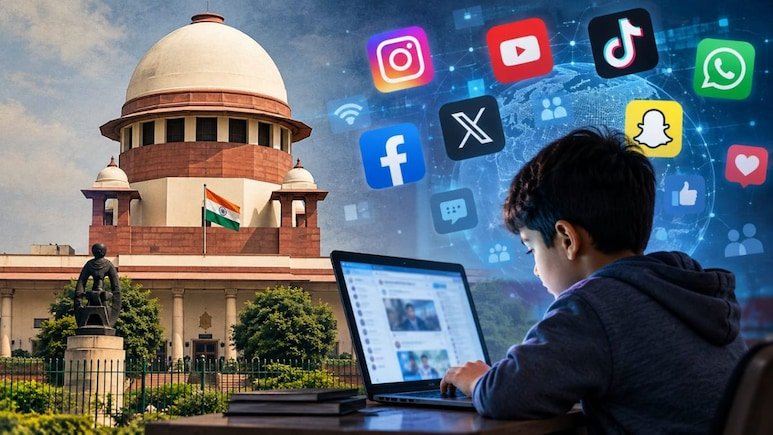
NEW DELHI — Refusing to enforce sweeping age restrictions on digital connectivity, the Supreme Court of India ruled that internet access constitutes a fundamental constitutional right for children, while ordering strict technical mechanisms to eradicate abusive media from social platforms.
A divisional bench led by Justices J.B. Pardiwala and K.V. Chandran handed down the order during hearings on child protection petitions, holding that arbitrary age bans fail to protect young citizens while unnecessarily curtailing constitutionally protected freedoms.
Key Takeaways
-
Constitutional Rights Upheld: The Supreme Court affirmed that digital access is protected under Article 21 and Article 19(1)(a) of the Constitution for all individuals, regardless of age.
-
Prohibitory Bans Dismissed: The court rejected requests for age-based internet restrictions, noting that prohibitions fail to deter digital access and instead leave minors unprotected in unregulated spaces.
-
Technical Safeguards Mandated: Tech companies and digital platforms must implement compulsory parental controls, restricted child modes, and automated moderation to filter explicit content.
-
Central Database Directives: The Union Government was ordered to deploy perceptual hash-matching algorithms and build a unified national registry of illicit digital links to accelerate content takedowns.
Constitutional Protection for Minor Citizens
Responding to filings by the Just Rights for Children Alliance concerning online child sexual exploitation and abuse material (CSEAM), the court emphasized that digital safety must be achieved through regulation rather than disenfranchisement.
“We have no hesitation in saying that the right to access and use the internet is a fundamental right of every individual… Our children, irrespective of their age, enjoy the same rights, and to deny the same altogether would be as absurd as saying children below a certain age do not have a conscience worth protecting… The safety of our children and their freedom are not at odds with each other.”
Expressing concern over commercial platforms hosting redirect links to illicit content, the bench called out administrative inaction and demanded immediate accountability from tech intermediaries.
Standard Operating Procedures for Intermediaries
To enforce compliance, the Supreme Court directed the Union Government to establish formal standard operating procedures (SOPs) governing hash-matching and digital URL tracking.
Social media networks and web hosts were instructed to maintain active zero-tolerance mechanisms, ensuring that non-consensual exploitative content is flagged and removed before reaching impressionable users.