



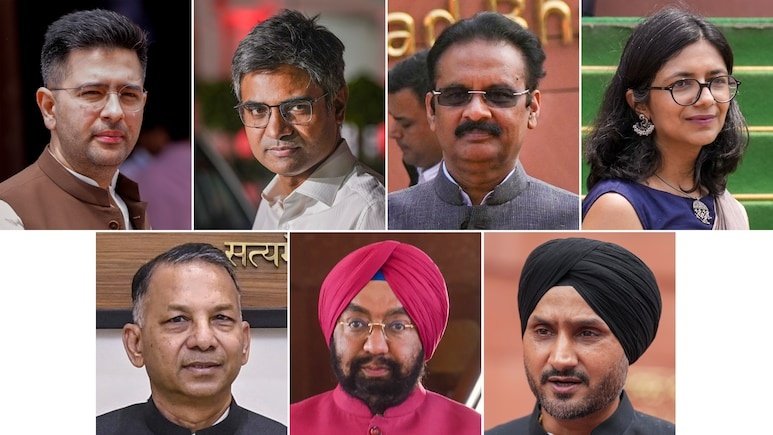
NEW DELHI — In a decisive blow to the Aam Aadmi Party (AAP), Rajya Sabha Chairman C.P. Radhakrishnan has officially accepted the merger of seven rebel AAP MPs with the Bharatiya Janata Party (BJP). The ruling, issued today, reduces the AAP’s presence in the Upper House to a mere three members while bolstering the BJP’s strength to 113.
The decision comes just days after the group, led by Raghav Chadha, petitioned the Chairman, citing that they represented more than two-thirds of the party’s legislative unit—the legal requirement to avoid disqualification under the Tenth Schedule.
The New Political Math
The merger fundamentally reshapes the representation of Delhi and Punjab in the Rajya Sabha:
-
The Punjab Sweep: Of the seven MPs representing Punjab, six are now with the BJP. Only one remains with the AAP.
-
The Delhi Split: In the national capital’s three-seat quota, the AAP now holds two seats (Sanjay Singh and N.D. Gupta), while Swati Maliwal is officially listed as a BJP member.
-
Total BJP Strength: The ruling party moves closer to a majority in the 245-member house, now standing at 113 members.
The Seven MPs Joining the BJP
-
Raghav Chadha
-
Sandeep Pathak
-
Harbhajan Singh
-
Swati Maliwal
-
Ashok Mittal
-
Vikramjit Singh Sahney
-
Rajinder Gupta
“Nation Building” vs. “Unconstitutional Betrayal”
The move has triggered a sharp war of words between the government and the AAP leadership.
Kiren Rijiju, Parliamentary Affairs Minister: Welcoming the MPs on X (formerly Twitter), Rijiju stated they had bid “goodbye to the Tukde-Tukde INDI Alliance.” He lauded the group for their conduct, noting they had “never resorted to abusive language” or “un-parliamentary conduct” during their tenure.
Sanjay Singh, AAP MP: The AAP has labeled the merger “unconstitutional.” Singh confirmed that the party has moved a counter-petition seeking the immediate disqualification of the seven members. The party maintains that the MPs have betrayed the mandate of the voters and strayed from the party’s core morals.
Legal and Strategic Implications
By meeting the two-thirds threshold (7 out of 10), the defecting group has effectively bypassed the immediate threat of the anti-defection law. However, the AAP is expected to challenge the Chairman’s decision in the Supreme Court, potentially leading to a landmark legal battle over the interpretation of legislative mergers.
For the BJP, the timing is impeccable. The influx of seasoned organizers like Chadha and Pathak—and high-profile figures like Harbhajan Singh—provides the party with significant momentum ahead of the 2027 Punjab Assembly elections.