



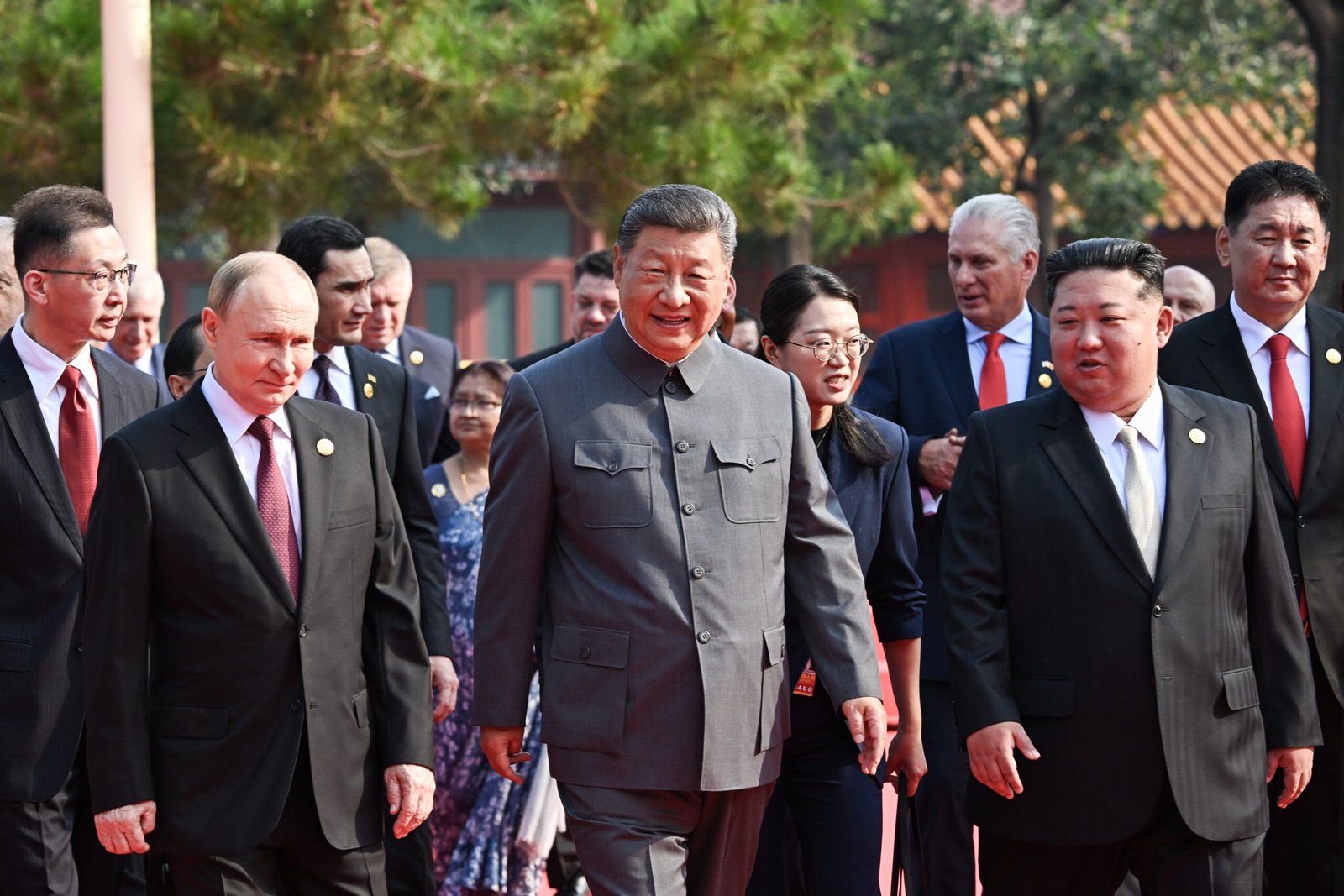
BEIJING: A high-profile display of solidarity among China, Russia, and North Korea has triggered rapid geopolitical realignments across the Indo-Pacific and transatlantic corridors. The strategic positioning of Vladimir Putin and Kim Jong Un alongside President Xi Jinping during the 80th-anniversary commemorations of World War II victory over Japan on September 3, 2025, was a deliberate message of resistance against Western hegemony.
However, security analysts warn that this high-stakes choreography is creating severe diplomatic blowback, strategically hemming in Beijing alongside unpredictable regional actors while fracturing its delicate relations with Europe and neighboring Asian democracies.
Indo-Pacific Rebalancing and Defense Accords
Far from deterring Western-aligned nations, the rare joint appearance in Beijing has accelerated a regional containment strategy that China has historically sought to avoid:
-
Rapid Defense Pacts: Just two days after the Beijing parade, Japan and Australia formalized agreements to tighten security cooperation in the Indo-Pacific. On September 11, 2025, a defense pact between Japan and the Philippines entered into force, permitting their respective armed forces to operate within each other’s territories.
-
Aggressive Military Maneuvers: Joint U.S.-Japan military drills commenced on September 11, featuring the Typhon intermediate-range missile system capable of targeting the Chinese mainland. Additionally, a massive trilateral defense drill involving the U.S., Japan, and South Korea was scheduled for September 15 to brace against Pyongyang’s nuclear capabilities.
Friction in Seoul and Tokyo
The trilateral summit threatens to completely alienate moderate leadership in South Korea and Japan, hardening domestic political consensus against Beijing.
In South Korea, the ruling Democratic Party—which had previously championed a friendlier, more cautious approach toward China compared to the hard-line administration of former President Yoon Suk Yeol—is facing immense pressure to overhaul its foreign policy. Observers noted that during the subsequent Xi-Kim summit on September 5, 2025, Beijing conspicuously omitted any mention of the “denuclearization of the Korean Peninsula,” a departure from their previous four meetings that South Korean media interpreted as a tacit acceptance of North Korea’s nuclear status.
Similarly, in Tokyo, the pro-China moderate stance of Prime Minister Shigeru Ishiba, who had taken office in October 2024 seeking to stabilize fractured Sino-Japanese ties, faces severe domestic strain as regional encirclement anxieties intensify.
Transatlantic Unity and Economic Risks
The geopolitical fallout has actively bridged political divides between the United States and the European Union:
-
The Authoritarian Label: EU Foreign Policy Chief Kaja Kallas openly condemned the parade as a manifestation of an “authoritarian alliance” designed to challenge the rules-based international order.
-
Economic Retaliation: The display threatens to derail China-EU trade, which saw China act as the EU’s largest source of imports (worth $609 billion) in 2024. Brussels is currently evaluating expanding anti-dumping measures and incorporating independent Chinese refineries into its latest sanctions regime against Russia.
-
The Trump Factor: While U.S. President Donald Trump’s “America First” agenda initially strained transatlantic bonds, the emergence of the Beijing-Moscow-Pyongyang axis prompted Trump to urge European leaders to escalate economic pressure on China, publicly accusing Beijing of directly financing Russia’s war efforts in Ukraine.
While the grand parade intended to project a new international order with Beijing at its center, it has instead solidified a formidable, unified counter-coalition across the globe.