



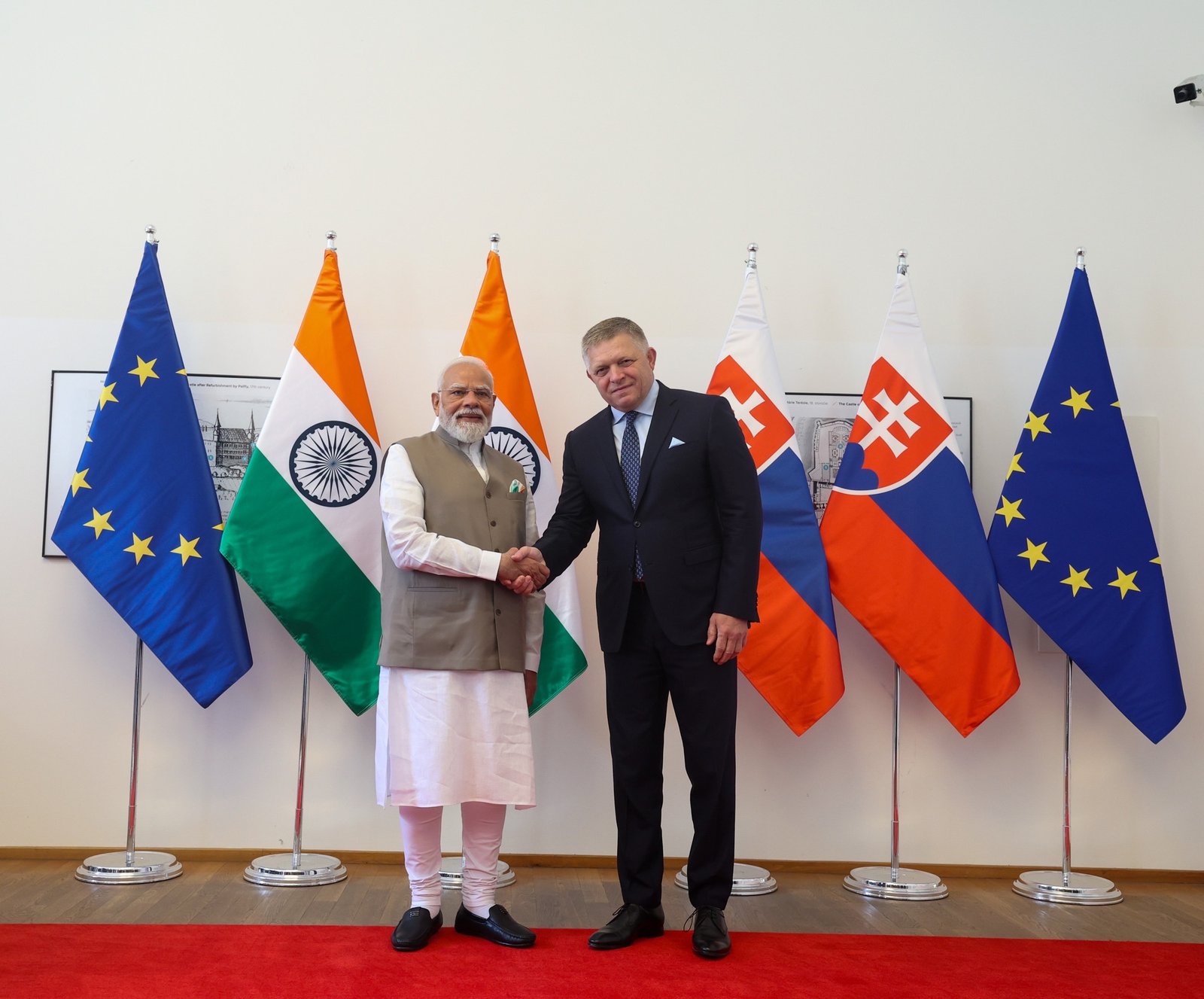
BRATISLAVA — In a historic diplomatic milestone marking the first-ever visit by an Indian Prime Minister to the Slovak Republic since its independence in 1993, Prime Minister Narendra Modi and Slovak Prime Minister Robert Fico issued a sweeping Joint Statement. The two leaders formally agreed to elevate their bilateral relationship to a Comprehensive Partnership, charting a highly strategic multi-sectoral roadmap across defense, advanced technology, trade, and regional security.
Recognizing the growing geopolitical importance of the Indo-Pacific and Central Europe, the transition shifts India-Slovakia relations from traditional friendly ties into an active, institutionalized strategic alliance.
1. Defense, Counter-Terrorism, and Sovereignty
The joint statement positioned defense and security cooperation as a foundational pillar of the newly elevated relationship, driven by joint industrial ambitions and a shared stance against global terror networks:
-
Strategic Defense Commitments: The leaders witnessed the signing of a Letter of Intent on Defense Cooperation, designed to foster joint research and development (R&D), capacity building, and defense industrial technology transfers.
-
The Pahalgam Condemnation: In a significant diplomatic alignment, both leaders unequivocally condemned cross-border terrorism, explicitly citing the heinous terrorist attack perpetrated in Pahalgam, Jammu and Kashmir, on April 22, 2025.
-
Institutional Security Mechanisms: To formalize real-time intelligence and operational coordination, the two nations established a dedicated Joint Working Group on Counter-Terrorism and called for the early finalization of the Comprehensive Convention on International Terrorism (CCIT) within the UN framework.
-
Multilateral Reform: Slovakia reaffirmed its constructive approach toward India’s entry into the Nuclear Suppliers Group (NSG) and backed India’s bid for permanent membership in a reformed United Nations Security Council (UNSC).
2. Deep Tech, Space, and Post-Quantum Cryptography
A core highlight of the partnership is a forward-looking technological framework aimed at safeguarding critical information networks against next-generation computing threats:
-
Post-Quantum Security: The nations signed a landmark Memorandum of Cooperation in Critical Infrastructure Protection and Post-Quantum Cryptography, focusing explicitly on preparing state information technology systems for post-quantum security transitions and emerging quantum threats to traditional cryptography.
-
The Digital Matrix: Following a Memorandum of Understanding (MoU) on Digital Technologies, the two sides agreed to collaborate on 5G use cases, 6G standardization, semiconductors, the Internet of Things (IoT), and machine-to-machine (M2M) applications.
-
Space and AI: Building on the successful AI Impact Summit 2026 held in Delhi (attended by Slovak President Peter Pellegrini), the nations agreed to launch joint ventures between their respective space ecosystems, focused primarily on satellite technology and its downstream applications.
3. Trade, Value Chains, and the India–EU FTA
The leaders aimed to exploit the structural complementarities between Slovakia’s highly developed Central European industrial footprint and India’s massive manufacturing scale:
-
EU-India Economic Horizon: Both prime ministers strongly welcomed the formal conclusion of negotiations on the India–EU Free Trade Agreement (FTA) in January 2026, calling for its early signing to diversify critical value chains and open fresh markets.
-
Industrial Focus: Enhanced two-way investments will be channeled through the India–Slovakia Joint Economic Committee, prioritizing high value-added manufacturing across the automotive, electronics, and railway sectors.
-
Energy Transition: Cooperative tracks were established to achieve net-zero emissions through technology exchanges in green energy, geothermal power, and nuclear energy diversification.
4. Mobility, Education, and Labor Migration
To protect the growing influx of skilled professionals and students moving between South Asia and Central Europe, a series of legal safeguards were put into place:
-
Labor Migration Framework: Aligned with the India-EU Comprehensive Framework of Cooperation on Mobility finalized in January 2026, the leaders signed an MoU on Cooperation in the Field of Labour Migration to facilitate safe, legal, and orderly professional mobility.
-
Social Security and Consular Ties: The two sides committed to the early conclusion of a Social Security Agreement to safeguard the welfare and pensions of cross-border working professionals, backed by a newly established mechanism for regular consular consultations.
-
Academic & Cultural Links: Educational linkages were cemented via a new MoU on Higher Education and Research—focusing heavily on STEM and humanities disciplines—alongside an MoU on Audio-visual Creation to facilitate joint film and media production.