



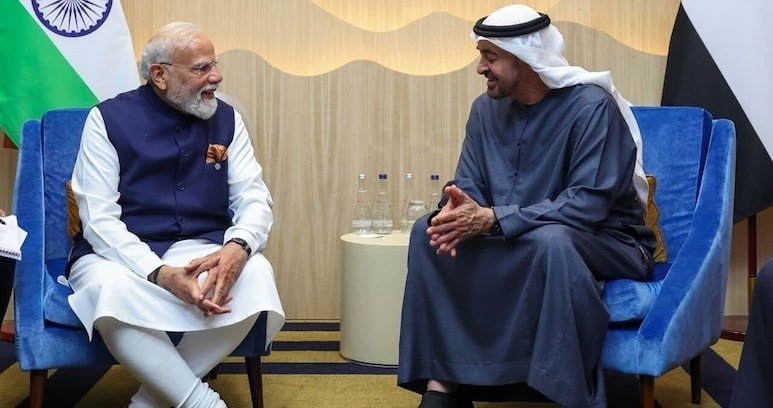
ÉVIAN-LES-BAINS (FRANCE) — Holding high-level talks on the sidelines of the G7 Summit, Indian Prime Minister Narendra Modi and UAE President Sheikh Mohamed bin Zayed Al Nahyan emphasized the critical need for dialogue, diplomacy, and adherence to international law to stabilize West Asia. Modi characterized the exchange as a “very good” session focusing on deep economic cooperation and joint regional security coordination.
The meeting marks the third summit between the two leaders in 2026, highlighting the rapid institutional momentum of the India-UAE Comprehensive Strategic Partnership.
West Asia Stability and the Hormuz Energy Corridor
The bilateral discussions occurred at a pivotal geopolitical moment, following closely on the heels of US President Donald Trump’s announcement of a landmark peace framework between Washington and Tehran to resolve their 107-day war:
-
Securing Global Supply Lines: With the conflict triggering a severe global energy crisis due to the closure of the Strait of Hormuz—a bottleneck handling roughly 20% of the world’s petroleum supplies—both India and the UAE issued a joint call for free, safe, and unimpeded maritime trade through the passage.
-
The Reopening Timeline: Per the active US-Iran diplomatic roadmap, the naval blockade of Iranian ports is slated to lift, with the Strait officially reopening for commercial shipping this coming Friday.
-
Sovereignty and De-escalation: Backed by the Ministry of External Affairs (MEA), PM Modi stressed that enduring regional stability relies heavily on absolute respect for state sovereignty, territorial integrity, and diplomatic channels over military confrontation.
Consolidating the India-UAE Partnership
Beyond regional security, the leaders reviewed the concrete trade and economic milestones achieved since their previous interactions earlier this year in January and May:
-
Multi-Sector Progress: Discussions focused on accelerating joint initiatives across tech integration, bilateral trade volumes, cross-border investments, defense manufacturing, and green energy security.
-
Diaspora Welfare: Prime Minister Modi extended formal gratitude to President Al Nahyan for the continued institutional care and security provided to the 4.3 million-strong Indian diaspora residing in the UAE.
-
BRICS Invitation: Looking toward the upcoming expansion of alternative multilateral forums, Modi formally invited the UAE President to attend the BRICS Summit, which India is slated to host later this year.
Direct Bilateral Outreaches on the G7 Margins
Operating as an invited guest country at the G7 Summit, India systematically advanced its strategic interests through a series of rapid bilateral engagements with key international partners:
-
South Korea: Modi met with President Lee Jae-myung to build on progress from his state visit to India two months prior, prioritizing futuristic tech joint-ventures, trade, and commercial integration.
-
Japan: In a strategic session with Prime Minister Sanae Takaichi, the leaders pledged to intensify deep-tech partnerships, supply-chain resilience, and high-velocity infrastructure investments.
-
Egypt and Kenya: Discussions with Egyptian President Abdel Fattah El-Sisi focused on historical security ties, while talks with Kenyan President William Ruto centered on amplifying the economic and developmental voice of the Global South.