



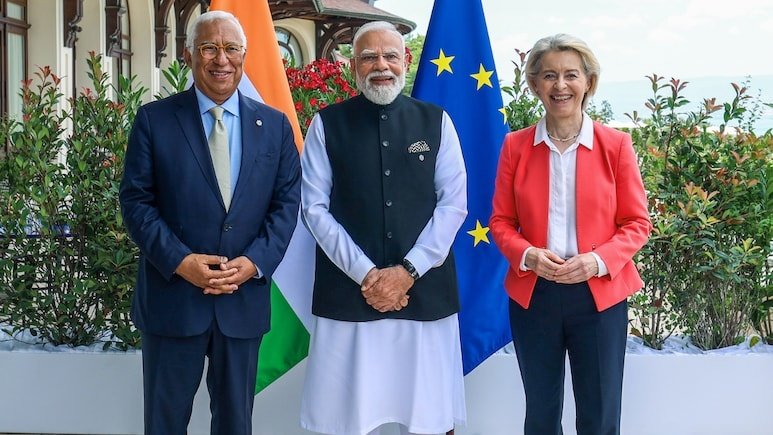
EVIAN, FRANCE — In a historic breakthrough for global commerce, India and the European Union are fast-tracking the formal execution of their newly concluded Free Trade Agreement (FTA), establishing a strict deadline to sign the pact by the end of 2026.
The diplomatic push materialized during a high-profile meeting between Prime Minister Narendra Modi, European Council President Antonio Costa, and European Commission President Ursula von der Leyen on the sidelines of the G7 Summit in Evian.
The “Mother of All Trade Deals”
The breakthrough follows the successful wrapping up of multi-year negotiations, originally ironed out during the 16th India-EU Summit in January. The trade pact is being hailed as an economic game-changer:
-
Timeline Lock-In: European Commission President Ursula von der Leyen publicly confirmed that the comprehensive FTA will be officially signed before December 31, 2026.
-
Investment Standalone Pact: Alongside the core trade agreement, negotiations are being aggressively accelerated on a separate, parallel investment protection treaty designed to guarantee long-term asset security for corporate investors.
-
Supply Chain Diversification: The Ministry of External Affairs (MEA) characterized the FTA as a “historic achievement” aimed at lowering tariff barriers, unlocking market access, and insulating bilateral commerce from global geopolitical shocks.
Advancing the IMEC and Strategic Corridors
The leaders heavily prioritized transcontinental connectivity, putting the spotlight directly back on alternative logistical networks:
The IMEC Revival: Central to the infrastructure deliberations was the India-Middle East-Europe Economic Corridor (IMEC). Both New Delhi and Brussels pledged to intensify development on this flagship multi-modal rail, port, and digital data corridor to construct a resilient trade superhighway bypassing traditional vulnerable maritime routes.
Sector Overview: The Joint Strategic Agenda
The leaders also audited bilateral milestones under the Joint India-EU Comprehensive Strategic Agenda. Moving forward, cooperation will systematically expand across five high-tech and infrastructure pillars:
| Strategic Pillar | Target Areas of Execution |
| Connectivity & Logistics | Rapid acceleration of IMEC transit corridors and port link optimizations. |
| Defense & Security | Joint maritime security maneuvers and military-industrial co-production. |
| Clean Energy & Sustainability | Technology transfers in green hydrogen, solar grids, and carbon reduction. |
| Digital Transformation | Joint frameworks on secure semiconductor supply chains and AI governance. |
| Global Order Alignment | Strengthening multipolar diplomatic coordination in West Asia and international forums. |
A Resilient Democratic Coalition
The MEA emphasized that as two of the world’s largest democratic entities operating open-market economies, the deep strategic convergence between India and the EU serves as an essential stabilizer for a multipolar world order. If finalized by December, the FTA will stand as one of India’s most consequential trade achievements in modern history.