



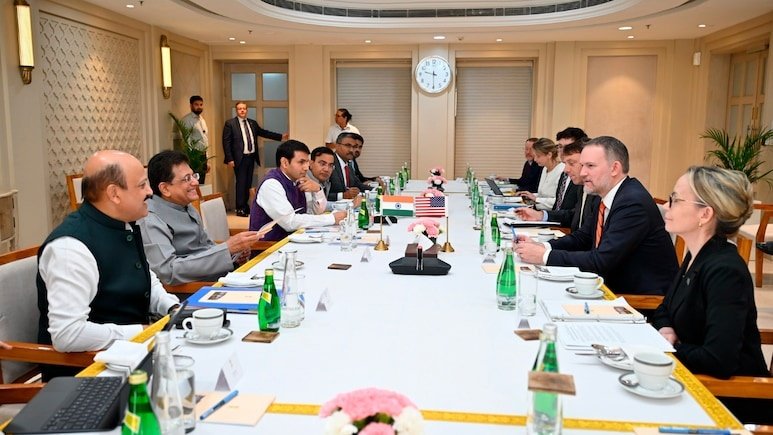
NEW DELHI — In a critical move to salvage and recalibrate their economic partnership, India and the United States have concluded intensive two-day ministerial-level talks aimed at finalizing the first phase of a bilateral trade agreement (BTA).
United States Trade Representative (USTR) Jamieson Greer led an official delegation to the capital from June 22–24, holding multiple rounds of discussions with Union Commerce and Industry Minister Piyush Goyal. The high-stakes meeting comes as both nations race against a July 24 deadline, when Washington’s temporary 10% global import tariff is set to expire.
Navigating Tariff Volatility: Why the Talks Were Critical
The New Delhi meeting was vital for resetting the trade parameters after recent shifts in US tariff policy upended a framework agreement finalized earlier this year.
-
The Supreme Court Shift: Under an initial February 7 framework, the US had agreed to cut tariffs on Indian goods from 25% to 18%, giving India a competitive edge over regional rivals like Vietnam. However, a subsequent US Supreme Court ruling struck down Washington’s sweeping tariffs, forcing the Trump administration to instead impose a temporary 10% global tariff under Section 122 of the Trade Act, effective for 150 days from February 24.
-
The July 24 Deadline: Because the temporary 10% tariff expires on July 24—restoring normal Most Favored Nation (MFN) tariff rates—both sides are working rapidly to secure an interim deal that preserves preferential market access for Indian exporters.
-
The Section 301 Leverage: Negotiations are also factoring in two Section 301 investigations launched by the USTR in March regarding excess industrial capacity and supply-chain labor concerns, which include India and could be used to adjust future tariff structures.
Core Negotiating Vectors and Concessions
The two ministers conducted a comprehensive review of the first phase of the pact, noting that negotiating teams have made substantial progress on several sensitive commercial fronts:
-
Agricultural and Industrial Access: Under the proposed terms, India has offered to eliminate or significantly reduce tariffs on US industrial goods and a wide spectrum of agricultural imports, including tree nuts, fresh/processed fruits, soybean oil, wine, spirits, and animal feed components like Dried Distillers’ Grains (DDGs) and red sorghum.
-
The $500 Billion Purchase Blueprint: To rebalance the economic relationship, New Delhi has outlined plans to procure $500 billion worth of US energy products, coking coal, aircraft, precious metals, and technology over the next five years.
-
Digital Trade & Supply Chains: The talks heavily emphasized digital trade frameworks, non-tariff barrier reductions, and building trusted, resilient supply chains amid highly volatile global trade dynamics.
Re-Energizing the Economic Engine
The ministerial talks follow a crucial meeting between Prime Minister Narendra Modi and US President Donald Trump on June 17 on the sidelines of the G7 Summit in France, which injected fresh political momentum into the text-based negotiations.
“I appreciate Ambassador Greer’s leadership and the sustained efforts of both teams in advancing our discussions in a constructive and forward-looking manner. We reviewed the progress of the ongoing India-US trade discussions to build resilient, trusted supply chains.” — Piyush Goyal, Union Commerce and Industry Minister
The US remains India’s second-largest trading partner. During the 2025–26 fiscal year, India’s exports to the US grew marginally to $87.3 billion, while imports from the US jumped nearly 16% to $52.9 billion, narrowing India’s trade surplus to $34.4 billion. Concluding this interim pact is viewed by both capitals as an essential stepping stone toward a comprehensive, long-term BTA.