



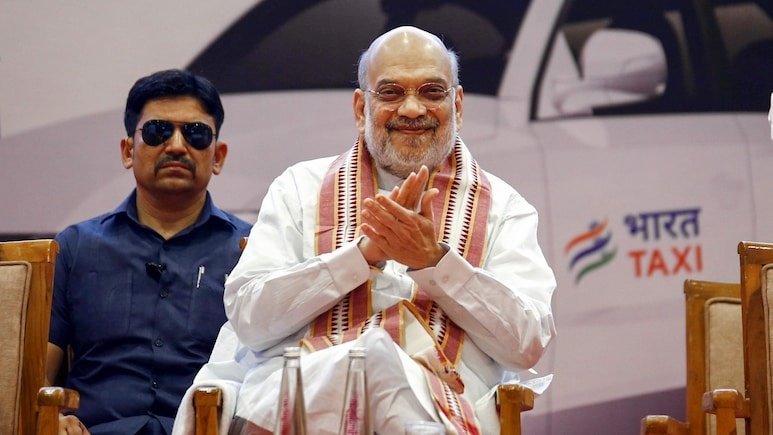
GANDHINAGAR — Union Home Minister Amit Shah officially rolled out Bharat Taxi, a new ride-hailing platform built entirely on a cooperative business model, in Gujarat on Saturday, June 27, 2026. The initiative aims to challenge corporate dominance in the aggregation sector and establish a fairer ecosystem for transit operators.
During the launch, the Home Minister drew direct structural parallels to the iconic Amul dairy model, highlighting how cooperative frameworks can successfully thrive alongside massive private entities when backed by the community.
Direct Challenge to Private Monopolies
Taking aim at existing app-based aggregators, Shah accused private tech platforms of systematically exploiting their workforces by taking excessive commission cuts, arbitrarily deleting operator accounts, and designing opaque performance metrics.
Refusing to use the word “drivers,” the Home Minister referred to the transport operators as saarthis (charioteers) to emphasize their vital economic contributions.
“Other apps used to exploit the drivers. I give you a guarantee that this will not happen in Bharat Taxi. Today, I say with pride that 7 lakh drivers are owners of the company. They will get respect, as well as security and prosperity.” — Amit Shah, Union Home Minister
The Co-Ownership Model: At a Glance
The newly launched platform aims to secure long-term financial stability for its workers through a localized, public-backed structure:
-
7 Lakh Shareholder-Owners: Over 700,000 operators have already registered as equity co-owners of the cooperative enterprise, ensuring profits are distributed directly back to the workforce rather than private corporate boards.
-
Multi-Modal Operations: The application is set to operate across multiple vehicle form-factors in Gujarat, including two-wheelers, auto-rickshaws, and traditional four-wheelers.
-
Institutional Integrations: Following successful trial runs, the platform has already signed strategic Memorandums of Understanding (MoUs) with major transit nodes, including the Ahmedabad Airport and the local municipal corporation, to set up dedicated pickup hubs.
Addressing Predatory Pricing Allegations
Shah dismissed ongoing media reports alleging that the cooperative application charges higher baseline rates than its competitors. He criticized private ride-hailing giants for temporarily lowering their prices, characterizing the practice as a predatory market tactic designed to bankrupt the newborn cooperative.
“The pattern of lowering prices adopted by other apps is designed to bankrupt Bharat Taxi so that Bharat Taxi leaves the market,” Shah remarked. “For how long will you keep doing this? Neither will Bharat Taxi get tired, nor will it leave the battlefield. Bharat Taxi is here to stay, and it will certainly succeed.”