



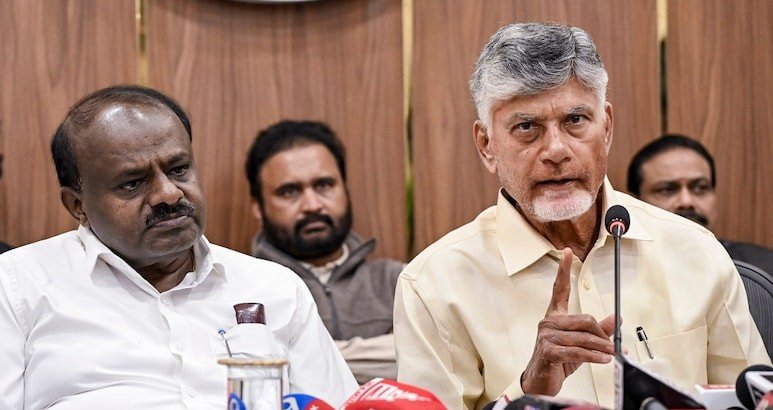
NEW DELHI — Andhra Pradesh Chief Minister N. Chandrababu Naidu extended his support to the central government’s push on constituency delimitation and the rollout of women’s reservation on Friday, November 27, 2026, while urging that the exercise account for demographic achievements in southern states.
Speaking at a press conference in New Delhi alongside Union Minister H.D. Kumaraswamy and other Union ministers, Naidu said he had traveled to the national capital to back decisions taken by the National Democratic Alliance (NDA) government under Prime Minister Narendra Modi.
Backing Women’s Quota and Expanded Parliamentary Representation
Naidu noted that the NDA government is advancing under the principle of Sabka Saath, Sabka Vikas, adding that women’s reservation—pending for nearly three decades—has reached a decisive phase. He emphasized that expanding the number of parliamentary constituencies is essential to keep pace with India’s population growth:
-
50 Percent Seat Expansion: Naidu stated that the Centre’s proposed formula provides a uniform 50 percent increase in seats across all states.
-
Population Growth vs. Frozen Seat Count: Citing historical figures, he observed that constituency limits have remained anchored to the 1971 Census following the 1976 delimitation exercise. While India’s population stood at 58.8 crore in 1971 with 542 Lok Sabha seats, he estimated the population had risen to nearly 147 crore in 2026 with the Lower House still capped at 543 seats—calling that strength inadequate for a country of India’s size.
-
Representation Ratios: Naidu pointed out that each Member of Parliament represented roughly 10 lakh citizens in 1971, compared with about 27 lakh people per MP today—and around 7.8 lakh per representative in the United States. Increasing Lok Sabha seats by 50 percent, he said, would bring the ratio down to one MP for every 18 lakh people. He also noted that India and China each have populations near 140 crore, projecting that India’s population could grow to double China’s by 2100.
Protecting Southern States That Curbed Population Growth
While backing the broader delimitation push, Naidu cautioned that southern states would be disadvantaged if seat allocation relied strictly on raw population counts from the 1971, 2011, and 2026 censuses:
-
Shift From Population Control to Management: Recalling intensive family-planning drives during his earlier tenure in undivided Andhra Pradesh that lowered fertility rates, Naidu explained that states that once operated in campaign mode to curb population growth have now shifted toward population-management policies backed by incentives.
-
Call for Equitable Safeguards: He reiterated that the delimitation process must protect the interests of southern states that successfully implemented population-control programs over the decades.