



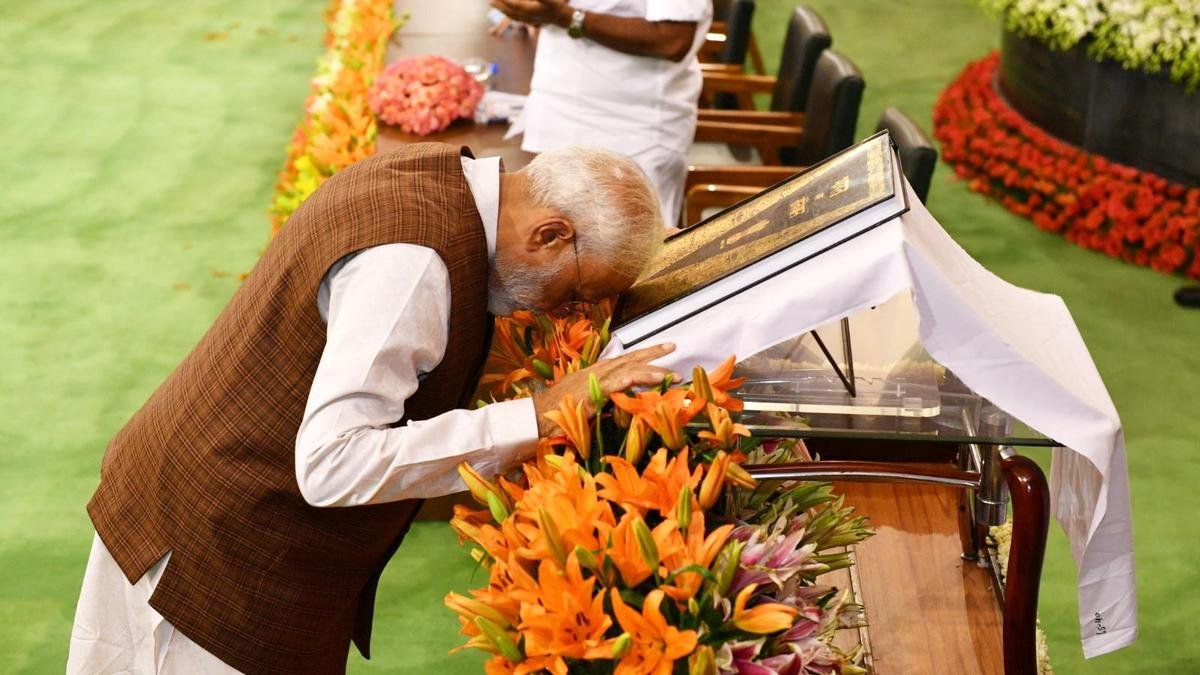
NEW DELHI — Marking Constitution Day on Thursday, November 26, 2026, Prime Minister Narendra Modi published an opinion piece on his website accusing the main Opposition party—an implicit reference to the Congress—of attempting to pare back Other Backward Classes (OBC) reservations to introduce religion-based quotas for Muslims.
Commemorating the Constituent Assembly’s adoption of the Constitution on November 26, 1949, Modi described the alleged push for Muslim quotas as “most appalling,” arguing that it runs directly counter to the principles upheld by the Constitution’s architects, particularly Dr. B.R. Ambedkar. Offering tributes to Rajendra Prasad, Ambedkar, and other Constituent Assembly members, he recalled that his administration designated November 26 as Constitution Day more than ten years ago to foster a deeper public bond with the Constitution.
Criticism of Parliamentary Conduct and the Women’s Quota Vote
Modi used the essay to fault Opposition parties for stalling legislative business and blocking key reforms earlier in 2026:
-
From Opposition to Obstruction: Writing that the Opposition has increasingly behaved like an avrodh paksh (obstructionist camp) rather than a virodh paksh (constructive opposition), Modi stated that stalling democratic proceedings cannot replace constitutional accountability.
-
Setback on Women’s Reservation: Referring to the defeat of the women’s reservation bill earlier this year, Modi accused the same Opposition party of preventing its passage and showing “disdain for constitutional values,” while pledging to India’s nari shakti that no force can stop his government from securing justice for women. In April 2026, the Constitution (131st Amendment) Bill, 2026—designed to establish 33 percent reservation for women in the Lok Sabha and state legislatures alongside delimitation—failed to secure the mandatory two-thirds majority in the Lok Sabha after Opposition lawmakers objected to linking the quota with delimitation, a provision Congress MP Shashi Tharoor had criticized as “political demonetisation” and a “shift in political power.”
Indictment of Past Constitutional Amendments and Central Interventions
Aiming at “those who had the opportunity to govern India for five decades,” the Prime Minister contended that earlier regimes weakened constitutional safeguards through controversial amendments and dismissals of state governments:
-
Milestones of 1951 and 1976: Pointing out that 2026 marks the 75th anniversary of the First Amendment of 1951 and the 50th anniversary of the Emergency-era 42nd Amendment, Modi noted that an unelected provisional parliament enacted the First Amendment months ahead of India’s first general election to curtail fundamental liberties and silence dissent, while the 42nd Amendment restricted judicial review. He also encouraged young Indians to read the 38th and 39th Amendments to see the actions of what he called a “power-hungry and anti-constitutional leadership.”
-
Article 356 and Article 370: Modi highlighted the repeated invocation of Article 356 to topple elected state administrations, observing that one party used the provision nearly 100 times and a single former prime minister imposed it 50 times. He added that Articles 370 and 35A deprived Jammu and Kashmir of the full protections of the Constitution for over 70 years—impacting Scheduled Castes (SC), Scheduled Tribes (ST), OBC communities, and women—until those provisions were repealed in 2019.
Internal Security, Social Mobility, and Welfare Delivery
Turning to internal security and socio-economic progress, Modi described the end of Maoist insurgency this year as “particularly heartwarming,” noting that tribal communities can now exercise their constitutional rights free from intimidation, while warning against “dimagi Naxals” who remain out of step with modern India and try to hinder national development.
Calling the Constitution an “inseparable part of our life journeys,” Modi reflected on his own modest upbringing, writing that the circumstances of a person’s birth no longer cap their future possibilities. Invoking constitutional historian Granville Austin‘s view of the Constitution as “first and foremost a social document,” the Prime Minister pointed to a World Bank assessment showing that nearly 50 crore Indians have exited poverty, and cited National Democratic Alliance (NDA) schemes—including PM Awas Yojana, Ujjwala Yojana, and Ayushman Bharat—as milestones in translating constitutional ideals into everyday welfare.