



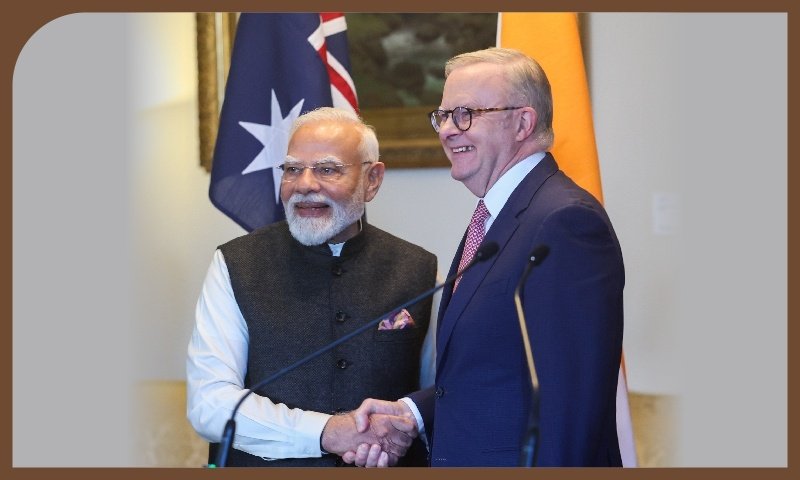
CANBERRA / NEW DELHI — In a major push to deepen Indo-Pacific ties, the Prime Minister of India’s official visit to Australia culminated in an extensive array of strategic agreements, spanning defense upgrades, critical energy pacts, major education partnerships, and the repatriation of priceless heritage artifacts.
The bilateral talks underscore a rapidly converging vision for a secure, resilient, and technologically advanced regional partnership.
1. Defense and Maritime Security Take Center Stage
Front and center of the discussions was a comprehensive security upgrade. The two nations signed the Joint Declaration on Defense and Security Cooperation (JDDSC), renewing their previous 2009 security pact. The updated framework zeroes in on:
-
Military interoperability, capacity building, and cyber security.
-
Unified approaches toward UNCLOS, ASEAN, and the Indian Ocean Rim Association (IORA).
Complementing this is the new Maritime Security Collaboration Roadmap (MSCR), geared toward enhancing real-time information sharing and operational coordination. On the enforcement front, a new MoU was sealed between the Indian Coast Guard (ICG) and Australia’s Maritime Border Command (MBC).
Signaling deep institutional trust, Australia has extended an invitation for an Indian military instructor to join the Australian Defense College for the 2028–29 academic year.
2. Breakthroughs in Civil Nuclear and Green Energy
A major milestone was achieved with the finalization of the Administrative Arrangement of the India-Australia Civil Nuclear Agreement. This operationalizes a framework originally signed in 2014, clearing the path for the supply of Australian uranium to India to fuel its expanding zero-emission energy grid.
The leaders also issued a Joint Statement on Energy Security to protect critical supplies against shifting global geopolitics.
Concurrently, local green initiatives received a boost with the operationalization of the Rooftop Solar Training Academy at Pandit Deendayal Energy University in Gandhinagar. Supported by India’s PM Surya Ghar Yojana, the academy aims to train 2,000 women and youth as specialized solar technicians.
3. Technology, Critical Minerals, and Supply Chains
With global supply chains under strain, the two nations launched the Australia-India Partnership for Cyber, Critical Technologies, and Supply Chains (PACTS). Building on a 2020 framework, PACTS focuses on improving digital resilience and securing critical technology pipelines.
Furthermore, GeoScience Australia and the Geological Survey of India (GSI) inked a deal to modernize infrastructure and bring advanced exploration methodologies to the hunt for critical minerals. Trilateral cooperation also advanced under the Australia-Canada-India Technology and Innovation (ACITI) Partnership.
4. Globalizing Education and Vocational Skills
Australia’s top-tier academic institutions are officially establishing deep roots on Indian soil.
-
Letters of Intent and Approval were handed over to Flinders University to open a campus in Bengaluru, and to Victoria University to operate a campus in Gurugram.
-
A major agreement between the National Council for Vocational Education and Training (NCVET) and the Australian Skills Quality Authority (ASQA) will align occupational standards across key industries.
-
Western Australia’s TAFE partnered with India’s Ministry of Skill Development to build a Centre of Excellence in Mining and METS (Mining Equipment, Technology, and Services) in Bhubaneswar, enabling cross-border student exchanges.
5. Cultural Ties and Biotech Research
In a major victory for India’s cultural heritage, Australia officially repatriated three rare, centuries-old Indian artifacts from Tamil Nadu:
-
The sacred granite bull Nandi (11th–12th century)
-
A bronze Trident with Auspicious Kali (11th century)
-
A basalt sculpture of the six-headed Skanda / Karttikeya (12th century)
On the scientific front, India’s CSIR signed an access agreement to open its Traditional Knowledge Digital Library (TKDL) to IP Australia. Additionally, CSIR partnered with the University of Melbourne for joint research into drug target identification and faculty exchanges.
Expanding into the arts, the Satyajit Ray Film and Television Institute (SRFTI) in Kolkata established a creative framework with the Griffith Film School in Brisbane for joint cinema projects and summer schools.
The Takeaway: This visit transitions the India-Australia dynamic from general diplomatic friendliness to highly specific, operational blueprints across defense, nuclear energy, and transnational education.