



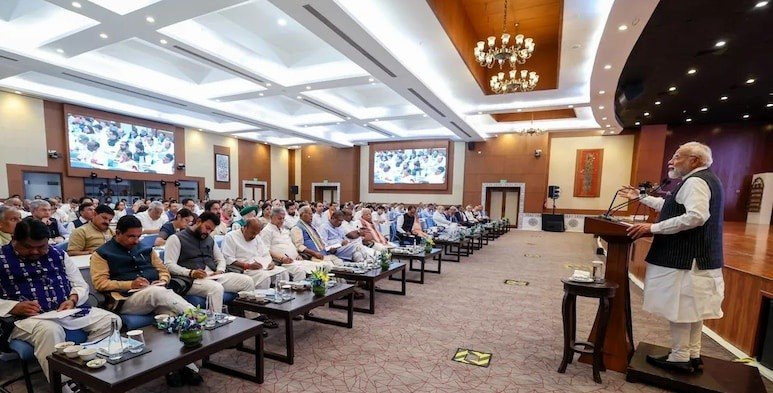
NEW DELHI — Accelerating the government’s governance agenda immediately upon concluding his official visit to Seychelles, Prime Minister Narendra Modi chaired a high-level review meeting with secretaries of all central ministries today.
The apex interaction serves as a key mid-term performance evaluation and stocktaking exercise, signaling an aggressive push toward structural policy reforms and the optimization of administrative delivery mechanisms.
Driving Administrative Speed and Regulatory Ease
While the official details of the closed-door discussions remain confidential, highly placed bureaucratic sources indicate that the Prime Minister focused heavily on advancing the next generation of reforms aimed at improving the Ease of Doing Business (EoDB).
The meeting marks the Prime Minister’s second massive institutional interface with the top layer of the civil services in under two months, building directly on the mandate established during a joint session of the Union Council of Ministers and central secretaries on May 21.
Core Institutional Directives:
-
Operational Velocity: Eliminating multi-layered bureaucratic red tape to ensure rapid file movement and accelerated inter-ministerial decision-making.
-
Resource Maximization: A directive to central secretariats to maximize productivity vectors within minimum turnaround times.
-
Regulatory Reforms: De-cluttering existing policy frameworks to catalyze private capital influx and domestic industrial scaling.
Executive Architecture Context
The timing of this apex bureaucratic assembly underlines a coordinated strategy to align the administrative executive branch with political leadership goals across the vast Union apparatus.
The Federal Executive Matrix:
-
Chair: Prime Minister Narendra Modi
-
Key Participants: Central Secretaries of all Union Ministries
-
Council Oversight Framework: Anchoring a governance structure that comprises 30 Cabinet Ministers (excluding the PM), 5 Ministers of State (Independent Charge), and 36 Ministers of State.
Governance Impact: Focus on a Developed India
The Prime Minister’s deliberate, direct engagement with the permanent bureaucracy bypasses intermediate political channels, ensuring that the apex administrative leadership is directly accountable for executing the national development roadmap.
By demanding immediate efficiency gains and systemic agility from his secretaries, the meeting sets a strict operational tone for the upcoming legislative sessions, where major economic, infrastructure, and digital governance policies are slated for rollout.