



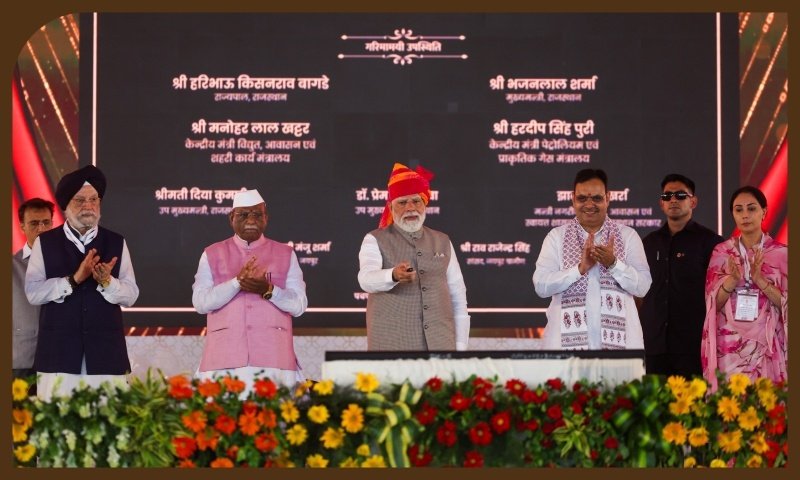
BALOTRA (RAJASTHAN) — In a massive boost to India’s energy, aviation, and water infrastructure, Prime Minister Narendra Modi visited Balotra, Rajasthan, to dedicate, inaugurate, and lay the foundation stones for a monumental suite of development projects valued at approximately ₹1.06 lakh crore.
Addressing a massive public gathering, the Prime Minister highlighted the resilience of “New India” in overcoming global economic shocks, while executing high-impact domestic projects to improve infrastructure and ease of living.
Key Infrastructure Milestones
1. The Rajasthan Refinery Dedicated to the Nation
The centerpiece of the development package is the Rajasthan Refinery, which has been officially dedicated to the nation.
-
Strategic Shift: Despite facing a temporary project setback due to an accident two months prior and historical delays between 2018 and 2023, the workforce accelerated operations to complete the facility.
-
Global Standing: The Prime Minister noted that while traditional global powers like the US and Europe are stagnant or shrinking their refining footprints, India has rapidly scaled up to possess the fourth-largest refinery capacity in the world.
2. Landmark Inter-State Water Agreement (Hathnikund Barrage)
Resolving a long-standing regional water dispute, a ₹34,000 crore agreement has been finalized between the state governments of Rajasthan and Haryana.
-
The Project: An underground pipeline will be laid from the Hathnikund Barrage to transport life-saving water directly to Rajasthan.
-
Beneficiaries: This pipeline will permanently address the water crisis in the arid Shekhawati region, directly benefiting residents across Sikar, Churu, and Jhunjhunu.
3. Aviation and Urban Transit Expansion
-
Jodhpur Airport Terminal: The Prime Minister inaugurated a state-of-the-art terminal building at the Jodhpur Airport to catalyze tourism, trade, and employment across the Marwar region.
-
Jaipur Metro Phase-2: The foundation stone was laid for the next phase of the Jaipur Metro, which will expand the city’s network beyond 50 kilometers, seamlessly integrating the East-West and North-South transit corridors.
Navigating the Global Energy Crisis
Reflecting on the geopolitical conflicts in West Asia, the Prime Minister detailed how the resulting supply disruptions triggered the “greatest energy crisis of the 21st century.” He broke down the emergency countermeasures that insulated Indian consumers from the global shock:
-
LPG Diversion & Configuration: Prior to the conflict, India imported 60% of its LPG (with 90% coming from the Gulf). When supply lines choked, domestic refineries were reconfigured within seven days to divert industrial gas into domestic cooking gas, boosting national production from 35,000 to 54,000 metric tonnes.
-
Price Caps & Consumer Protection: While international experts predicted cooking gas cylinders would soar to ₹2,000, the government capped prices below ₹950 (and under ₹650 for Ujjwala beneficiaries).
-
Absorbing Crude Losses: As global crude jumped from $70 to $120 per barrel forcing international fuel rationing, the central government absorbed a loss of over ₹75,000 crore between April and June alone, alongside slashing excise duty by ₹10 per liter to maintain uninterrupted supplies.
-
Diversified Fuel Sourcing: Through proactive diplomacy, India successfully expanded its oil import base from 25–26 countries to over 40 nations.
Green Energy & Rural Development
Underscoring a commitment to ecological balance, PM Modi planted a sacred Khejri sapling—a tree vital to preventing desertification in Rajasthan—and highlighted extensive green initiatives:
-
Over 1.5 lakh homes have been integrated under the PM Surya Ghar scheme.
-
More than 65,000 solar pumps have been deployed to local farmers via the PM Kusum Yojana.
-
Over 1.25 lakh soak pits have been built in Rajasthan under the Jal Sanchay, Jan Bhagidari campaign to revive groundwater tables.
-
A mass recruitment drive concluded with the distribution of government job appointment letters to 54,000 young candidates across the state.