



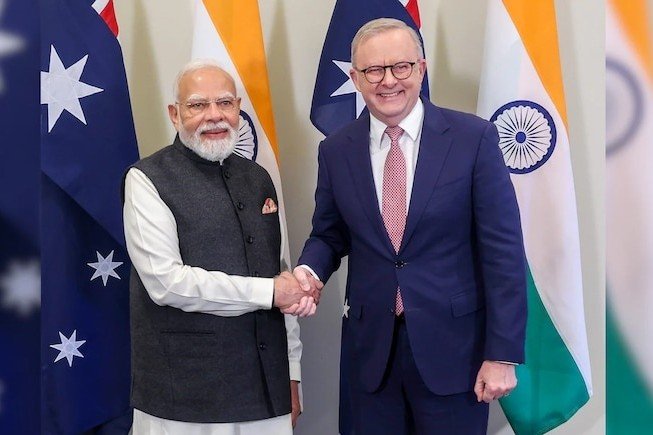
MELBOURNE — Terming the bilateral trade relationship a “win-win proposition,” Prime Minister Narendra Modi invited top Australian business leaders, institutional investors, and superannuation funds to take advantage of India’s rapid economic expansion and policy reforms.
Jointly addressing the Australia-India CEOs Forum and the Economic Roadmap Business event in Melbourne alongside Australian Prime Minister Anthony Albanese, PM Modi urged faster execution of the proposed Comprehensive Economic Cooperation Agreement (CECA) to unlock the next phase of bilateral business ties.
1. Capitalizing on India’s Scale and Australian Expertise
Addressing a gathering of more than 200 CEOs and institutional investors, PM Modi emphasized that the complementary strengths of India’s massive market scale and Australia’s specialized expertise present unmatched investment opportunities.
The Prime Minister highlighted a wide spectrum of strategic investment channels:
-
Industrial & Infrastructure: Manufacturing, national infrastructure, urban development, aviation, and advanced logistics.
-
Strategic & Future Technologies: Clean energy, critical minerals mining, semiconductors, defense supply chains, artificial intelligence (AI), and fintech.
-
Primary Sectors: Food processing and the broader digital economy.
2. Transition from ECTA to CECA
While expressing satisfaction over the surge in commercial trade following the Economic Cooperation and Trade Agreement (ECTA) signed in 2022, PM Modi emphasized that the two nations must formalize a deeper pact:
-
CECA Early Conclusion: He called on trade negotiators to conclude the proposed CECA swiftly to further eliminate regulatory friction and tariffs.
-
Strategic Joint Ventures: Business leaders were urged to collaborate on global supply chain solutions, specifically focusing on critical minerals like lithium, rare earths, batteries, electronics, and electric vehicles (EVs).
3. Decentralized Sub-National Alliances
In a strategic shift to deepen ground-level economic integration, PM Modi proposed a decentralized business model. He advised that individual Indian states and Australian provinces forge direct, dynamic economic partnerships based on their localized core competencies and industrial strengths, allowing for targeted and efficient capital deployment.
4. Higher Education and Human Capital
The forum also saw a strong representation from academia, including the vice-chancellors of top Australian universities. PM Modi welcomed the expanding physical presence of Australian higher education campuses in India, noting that deep research collaborations, innovation hubs, and joint skill development programs will create a globally competitive talent pool capable of servicing the future industries of both democracies.