



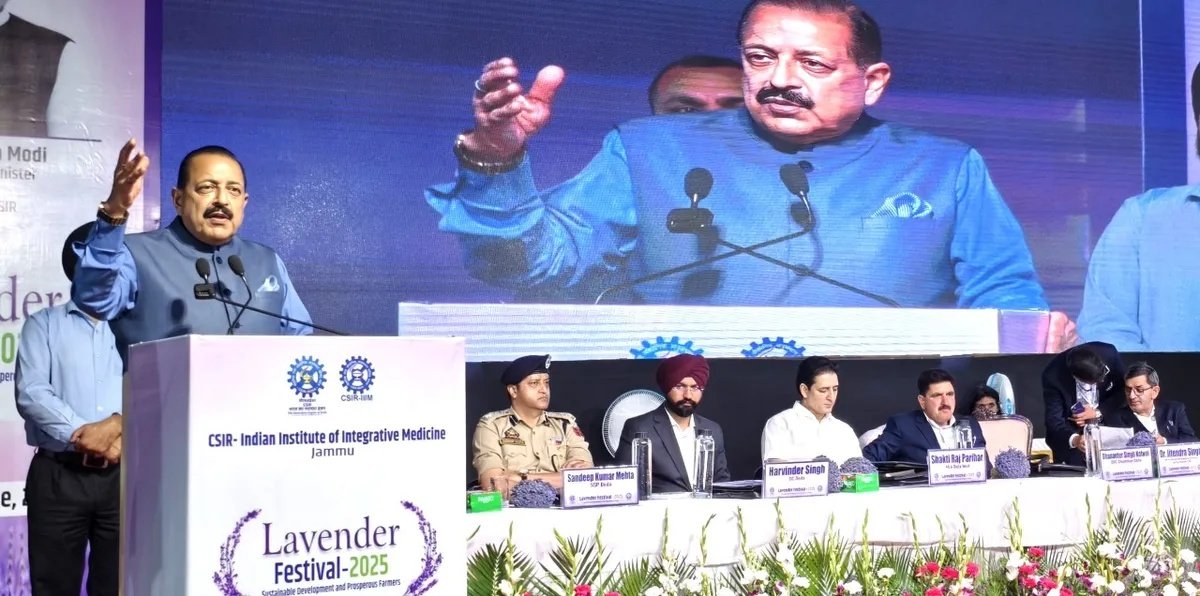
JAMMU / BHADERWAH: Highlighting a major agro-economic shift in Jammu and Kashmir, Union Minister Dr. Jitendra Singh officially inaugurated the 4th Lavender Festival in the picturesque Bhaderwah Valley. Often described as “Mini Kashmir,” the highland valley has rapidly evolved into India’s central hub for lavender cultivation, anchoring the union territory’s specialized “Purple Revolution” under the CSIR Aroma Mission.
The festival serves as an annual showcase of how science-driven agricultural interventions have replaced traditional, low-yielding maize farming with high-value floral extraction, creating a self-sustaining regional ecosystem for essential oil processing.
From Barren Land to High-Yield Startups
Reflecting on the initial structural challenges of introducing lavender to the region a decade ago, Dr. Jitendra Singh noted that the transition faced intense initial resistance from local communities hesitant to pivot away from ancestral crops:
“When we started, there were physical and mental hurdles. People weren’t ready to part with their land. So we began lavender cultivation on leftover patches and told villagers that if it doesn’t bear fruit, we’ll return their land. The entire village came forward when they saw early adopting farmers make a fortune overnight.” — Dr. Jitendra Singh
The Minister underscored that the success of the Aroma Mission has effectively broken standard corporate myths surrounding entrepreneurship. He highlighted that an agri-tech startup does not strictly require advanced tech degrees or doctorate qualifications, pointing to numerous local youth—including several who have not completed high school—who are now successfully managing independent lavender extraction and distillation units.
Infrastructure Overhaul & Proactive Governance
Connecting the regional agricultural success to broader developmental matrices, the Union Minister stated that the shift from reactive to proactive governance in J&K has stabilized logistical channels.
He pointed out that prior to 2014, the remotest hills of Bhaderwah completely lacked commercial road networks. Today, the area is connected via modern tunnels, national highways, expanding express corridors, and the extension of Vande Bharat rail services into Jammu and Kashmir. This infrastructure scaling has been critical in linking remote mountain farms directly to manufacturing industries across urban India.
The National Startup Scaleup: Highlighting the country’s broader economic trajectory, the Minister noted that India’s startup pool has surged from a mere 350 entities over a decade ago to more than two lakh active startups today, generating approximately 24 lakh jobs and positioning India as the world’s third-largest startup incubator.
The Export Constraint
While market integration has provided a steady domestic revenue stream for regional farmers, Dr. Jitendra Singh acknowledged that the primary constraint currently facing the Lavender Mission is scale.
While the established domestic industrial linkages consume the current output for cosmetics, therapeutic oils, and pharmaceuticals, local agencies are actively looking to step up aggregate production volume to meet international export demands. Prime Minister Narendra Modi’s highlighting of Bhaderwah’s lavender success during his Mann Ki Baat radio address has already institutionalized the destination on the national agri-tourism map, driving massive footfalls to the current festival.