



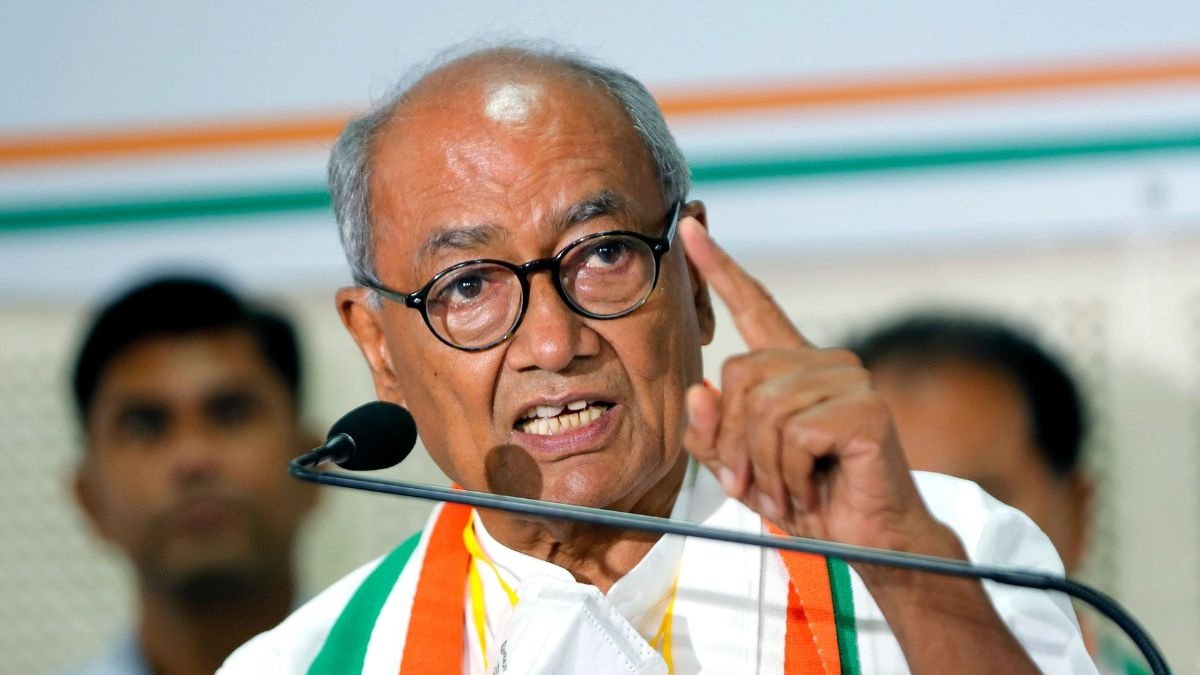
BHOPAL: A sharp political war of words has erupted in Madhya Pradesh after the Bharatiya Janata Party (BJP) heavily criticized the Congress party and its veteran leader Digvijaya Singh. The BJP accused the opposition party of being “anti-Hindu,” alleging that Congress leadership has historically viewed the majority community with hostility.
The ruling party’s aggressive pushback was triggered by remarks made by the former Madhya Pradesh Chief Minister during a party event held on the death anniversary of India’s first Prime Minister, Jawaharlal Nehru.
The Catalyst: Digvijaya Singh invokes Nehru’s Ideology
Addressing party workers at the Congress headquarters, Digvijaya Singh drew heavily from Jawaharlal Nehru’s historical stance against sectarian politics to critique the current political landscape.
-
The Core Argument: Singh stated that India is currently witnessing a dangerous surge in majoritarian communal politics.
-
The Ideological Reference: He reminded workers that Nehru had classified communalism as a poisonous force capable of fracturing the nation from within. Singh specifically emphasized Nehru’s historical warning that “majoritarian communalism is far more dangerous than minority communalism”.
-
Policy Critique: Beyond social issues, the senior Congress leader took a swipe at the central government, questioning the trajectory of India’s economy and suggesting that the country’s current foreign policy compromises national interests.
The BJP’s Counteroffensive: Accusations of Appeasement and Division
The BJP launched a fierce counter-narrative, with Bhopal BJP MLA Rameshwar Sharma leading the attack against Singh and the wider Congress establishment.
-
The Historical Analogy: Invoking the legacy of the 1947 Partition, Sharma questioned whether Hindus were responsible for breaking up the nation and sharply asked if Muhammad Ali Jinnah belonged to the majority community. He alleged that the Congress historically aligned with the architects of Partition and continues to protect divisive elements today.
-
Minority Politics Criticized: Sharma claimed that the Congress party’s brand of politics systematically spreads fanaticism and separatism. He argued that instead of integrating Muslims into the national mainstream, the opposition continuously isolates them to sustain a protective shelter for radical and anti-national elements.
The escalating rhetoric highlights the deeply entrenched ideological divide between the two major parties ahead of upcoming political cycles, with communal narratives and historical legacies once again taking center stage.