



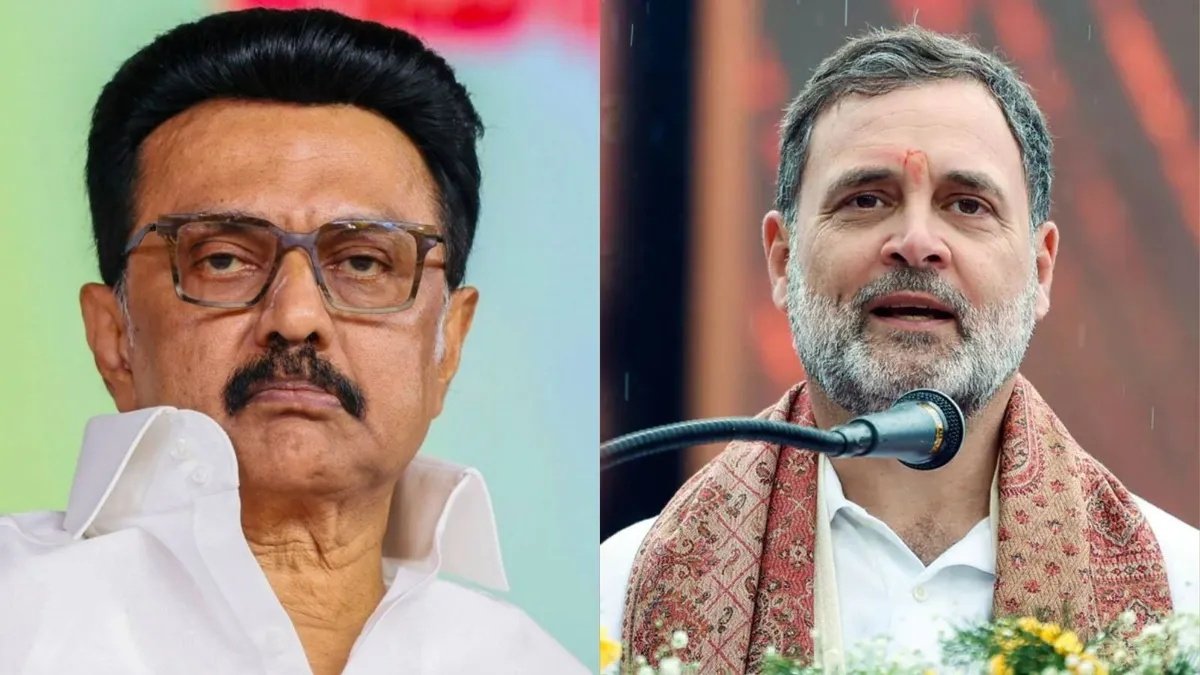
CHENNAI — The opposition INDIA bloc has suffered a severe blow in southern India as the DMK launched a scathing attack on Leader of the Opposition Rahul Gandhi. The DMK openly questioned his leadership credentials and blamed his strategic missteps for fracturing both national opposition unity and their long-standing state-level alliance.
The public falling-out marks a complete breakdown in relations between the two heavyweights, triggered by a sudden political realignment in Tamil Nadu that has left the DMK leading a diminished front.
Coordinated Attacks via Mouthpiece and Digital Wings
The DMK deployed its official communication channels to execute a sharp, dual-track critique of the Congress leadership’s political conduct:
-
The “Joke” Label: The DMK’s IT wing issued an unusually blunt public statement condemning the Congress’s tactical shifts. “We carried the INC on our shoulders when they were fighting for their political survival, only for them to jump ship the second they saw a shiny new toy,” the wing posted, concluding by calling Rahul Gandhi “a massive joke.”
-
The Murasoli Broadside: In tandem, the DMK’s official print mouthpiece, Murasoli, published a sharp editorial targeting Gandhi’s national strategy. The piece accused him of lecturing regional partners on cohesion while his own actions continuously sowed division across multiple states.
The Catalyst: The Congress–TVK Realignment
The direct cause of the bitter split lies in the immediate aftermath of the 2026 Tamil Nadu Assembly elections, which completely reordered the state’s political landscape:
-
The Alliance Exit: The Congress contested and secured five Assembly seats as a junior partner within the DMK-led bloc. However, shortly after the results were declared, the party abruptly abandoned the DMK.
-
Joining the TVK Government: The Congress swift moved to join the newly formed government led by actor-politician Vijay’s Tamilaga Vettri Kazhagam (TVK) as an active coalition partner.
-
High-Command Approval: Murasoli stressed that this swift political migration was executed with the clear knowledge and explicit backing of the Congress central leadership in New Delhi, rendering Gandhi’s calls for national unity hypocritical in the eyes of his former partners.
A Growing National Charge Sheet
The DMK’s criticism extended beyond local grievances, compiling a broader list of instances where Congress strategies have alienated key regional members of the INDIA bloc:
-
Targeting Allies in Kerala: The Murasoli editorial highlighted deep resentment among Left leaders in Kerala. It pointed to election campaigns where Gandhi actively demanded the arrest of Kerala Chief Minister Pinarayi Vijayan and accused the Left Democratic Front (LDF) of maintaining a secret understanding with the BJP. The paper argued that such attacks made it appear as though Congress prioritizes defeating its own allies over the ruling party.
-
The Delhi Boycott: Highlighting this deep operational divide, the DMK recently boycotted an INDIA bloc strategy session in New Delhi, explicitly stating it would refuse to attend any meeting convened under the stewardship of the Congress.
Congress Rebuttal
While the central leadership of the Congress has avoided entering a direct public slanging match with the DMK, internal party sources pushed back against the allegations of betrayal. Party insiders maintained that the decision to join the TVK government was a pragmatic move that aligned with local political realities and voter sentiment. “The Congress has respected the people’s mandate in Tamil Nadu,” a party source stated, denying that the move was designed to weaken the broader anti-BJP national front.