



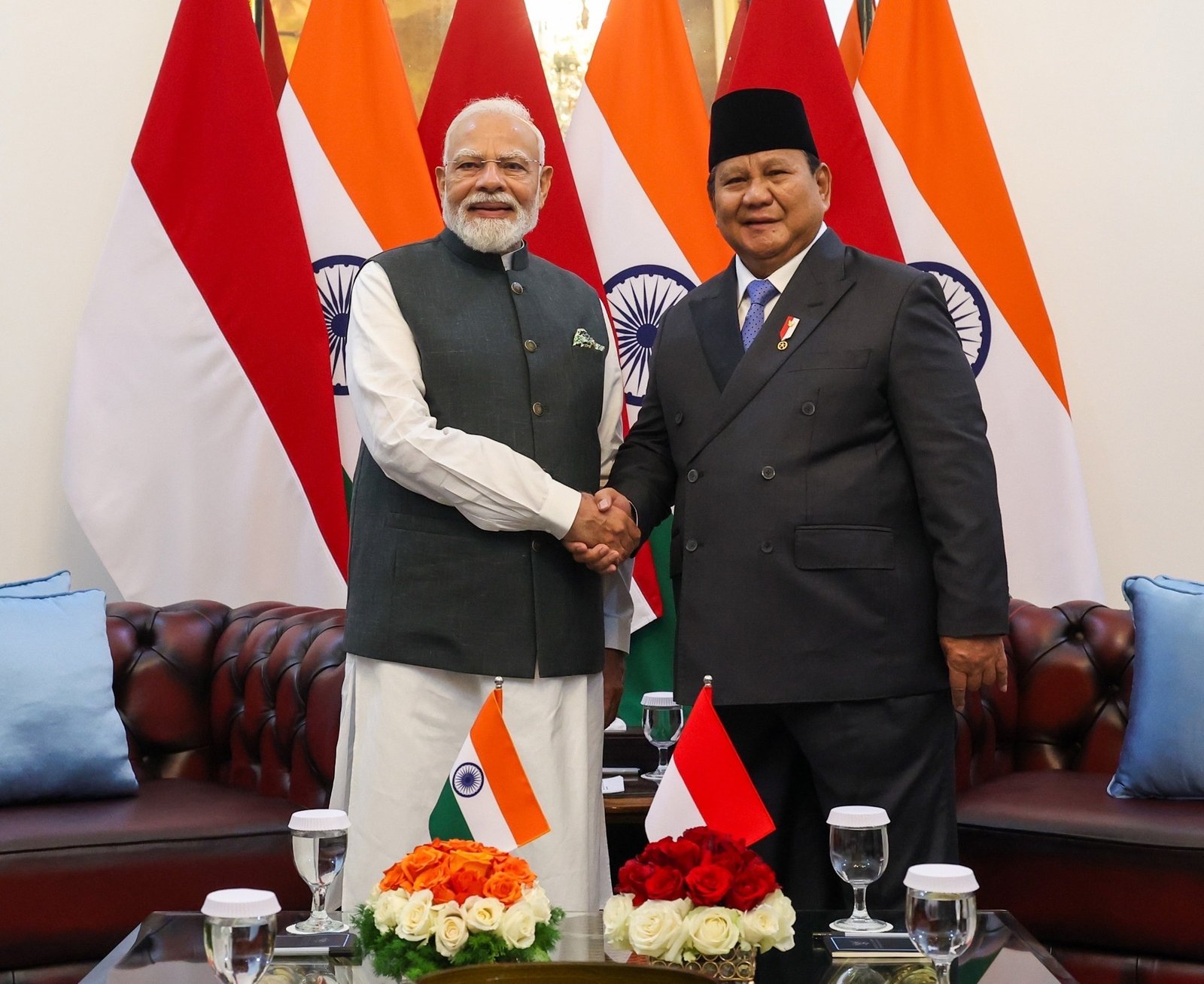
JAKARTA / NEW DELHI — At the invitation of Indonesian President Prabowo Subianto, Prime Minister Narendra Modi undertook a high-profile State Visit to Indonesia from July 6 to 8, 2026. Following President Prabowo’s visit to New Delhi in January 2025 as the Chief Guest for India’s 76th Republic Day, this summit marks a critical milestone in driving a substantial upward trajectory for the India-Indonesia Comprehensive Strategic Partnership.
During the visit, Prime Minister Modi received a ceremonial welcome at Istana Merdeka, engaged in delegation-level bilateral talks, addressed the Indonesian Parliament, and joined President Prabowo to inaugurate the restoration of the UNESCO World Heritage Prambanan Temple Compounds.
1. Expanding Defense, Maritime, and Security Alliances
Acknowledging their roles as close maritime neighbors in the Indo-Pacific, the two leaders prioritized concrete technology transfers and operational security integration over traditional defense procurement:
-
Advanced Missile Systems: The leaders formalized deep technical cooperation centered on the BrahMos Missile System alongside an all-new Air-to-Air Missile Cooperation Agreement.
-
Operational Integration: Highlighting a shared commitment to maritime security, an Indonesian International Liaison Officer (ILO) will be stationed at India’s Information Fusion Centre-Indian Ocean Region (IFC-IOR) in Gurugram. Furthermore, a new Implementing Arrangement was concluded between the Indian Coast Guard and Indonesia’s BAKAMLA RI.
-
Defense Industrial Cooperation: Joint efforts will expand into complex domains, including commercial ship-building, setting up Maintenance, Repair, and Overhaul (MRO) facilities for common defense platforms, and establishing collaborative defense R&D pipelines.
-
Zero-Tolerance Counter-Terrorism: Both nations agreed on an upcoming MoU on Cooperation in Counter Terrorism. They resolved to intensify intelligence sharing to disrupt online radicalization, tackle terror financing networks via FATF compliance, and curb the misuse of emerging technologies by globally proscribed terror entities.
2. Economic Integration, Critical Minerals, and Digital Architecture
The discussions focused heavily on aligning the economic goals of ‘Viksit Bharat 2047’ and ‘Indonesia Emas 2045’ to unlock diversified trade channels:
-
Critical Mineral Supply Chains: To lower manufacturing vulnerabilities, the nations signed a landmark MoU between the Non-Ferrous Materials Technology Development Centre (NFTDC), Midwest Ltd., and PT PERMINAS to develop rare earth magnets and secure critical mineral lines.
-
Heavy Industry Joint Venture: The Steel Authority of India Ltd. (SAIL) and PT Krakatau Steel entered into a Strategic Joint Venture to construct a Stainless-Steel Slab Manufacturing Facility in Indonesia.
-
Fintech & Local Currency Settlements: Progress was accelerated on the operationalization of Local Currency Transaction (LCT) guidelines between the Reserve Bank of India and Bank Indonesia, alongside the rapid implementation of a Cross-Border QR Payment Linkage.
-
Digital Commerce Export: The leaders welcomed the official launch of the Indonesia Open Network (ION), built entirely upon India’s Open Network for Digital Commerce (ONDC) architecture, to integrate Indonesian micro, small, and medium enterprises (MSMEs) into the digital economy.
3. Infrastructure, Healthcare, and Aerospace Science
-
Sabang Port Development: President Prabowo welcomed Indian investment to transform the strategic Sabang Port into an integrated maritime hub. The project will feature marine-tourism infrastructure, ship-repair yards, and shore-based services to support offshore energy activities in the Andaman Sea.
-
Space Port & Gaganyaan Mission: Building on the BRIN-ISRO collaborative framework, the leaders reviewed ongoing support for India’s manned Gaganyaan Mission through the Biak Telemetry, Tracking and Command (TTC) Facilities. Crucially, President Prabowo welcomed Indian participation in developing a new space port project in Indonesia.
-
Health and Food Security: A new Implementation Arrangement on Professional Health Workforce Development was sealed to drive clinical training fellowships. This is paired with an MoU between CDSCO and BPOM on Medical Products Regulation. To stabilize food grids, India committed to shipping fertilizer and high-grade agricultural yields to the region.
4. Cultural Diplomacy & Regional Governance
-
Tagore-Dewantara Year: To honor the mutual philosophical legacies of Rabindranath Tagore and Ki Hajar Dewantara, the year 2026–2027 was designated as the “Tagore–Dewantara Year of India–Indonesia Cultural and Educational Diplomacy,” kickstarting a centenary celebration of Tagore’s 1927 visit to the archipelago.
-
Global South Advocacy: The leaders demanded comprehensive, text-based reforms of the United Nations Security Council (UNSC) to reflect modern geopolitical realities. Indonesia affirmed its complete backing for India’s 2026 BRICS Chairship, while both sides pledged closer alignment within G20 and IORA frameworks to amplify the voice of developing nations.