



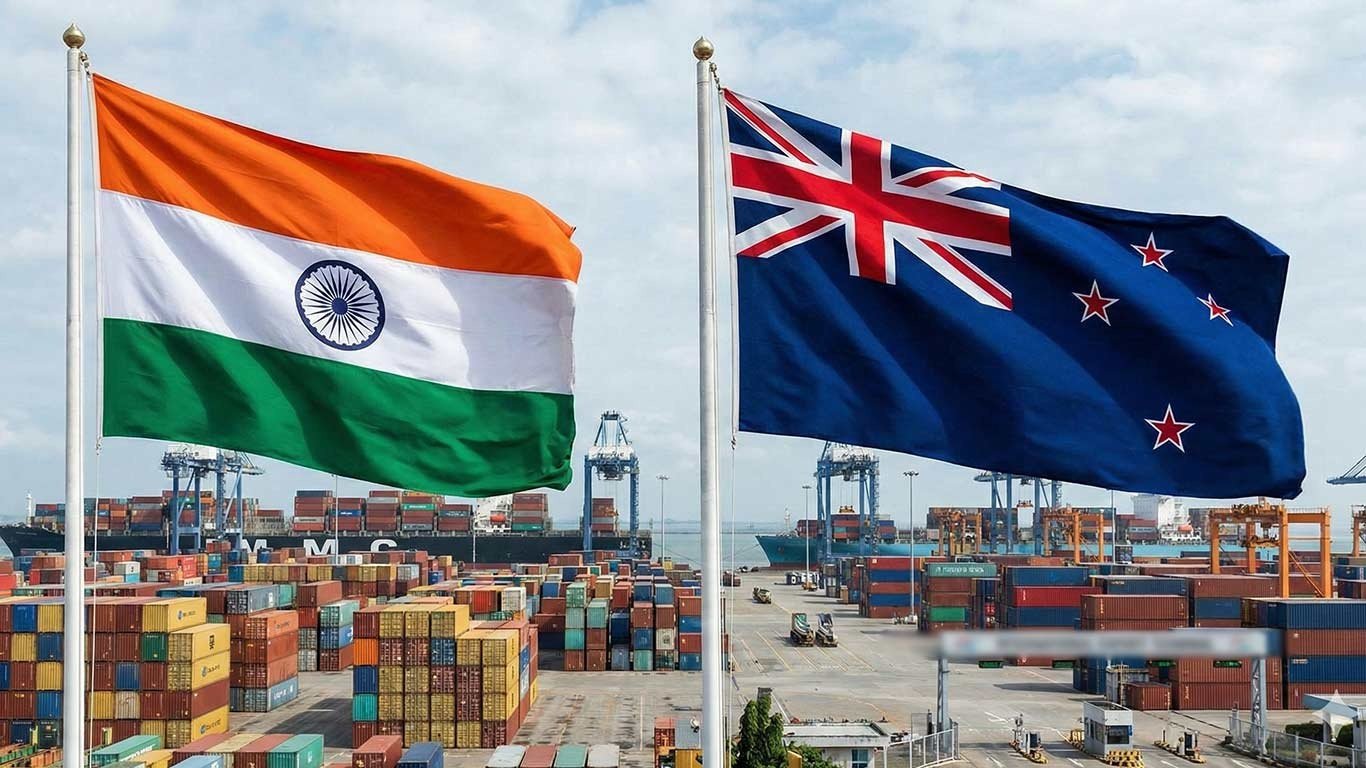
AUCKLAND — Marking the first official visit by an Indian Prime Minister to New Zealand in 40 years, Prime Minister Narendra Modi and New Zealand Prime Minister Rt Hon Christopher Luxon issued a historic joint statement in Auckland.
Recognizing a shared commitment to a free and open Indo-Pacific, democratic values, and deep economic ties, the two leaders officially elevated their bilateral relationship to a Strategic Partnership. To operationalize this new paradigm, both heads of state endorsed the ‘India-New Zealand Strategic Partnership: Roadmap to 2030’, which establishes a comprehensive framework for joint action over the next four years.
Bilateral Cooperation Framework (Roadmap to 2030)
The newly minted Strategic Partnership lays out ambitious, time-bound objectives across five core operational domains:
-
Political and Diplomatic Engagement: Establishing an institutionalized, regular Foreign Ministers’ Dialogue alongside annual senior officials’ meetings between India’s Ministry of External Affairs (MEA) and New Zealand’s Ministry of Foreign Affairs and Trade (MFAT). Parliamentary exchanges will be anchored by the newly constituted Parliamentary Friendship Group for New Zealand in the Indian Parliament.
-
Defense, Maritime Security, and Counter-Terrorism: Signing a Maritime Cooperation Arrangement (MCA), a Mutual Logistics Support Arrangement, and an Implementing Arrangement on Hydrography and Nautical Cartography to enable joint naval exercises. It also builds on operational synergy under Combined Task Force 150 (CTF-150) and sets up a new Joint Working Group (JWG) on Counter-Terrorism to dismantle transnational financial and digital terror networks.
-
Trade, Agriculture, and Economic Expansion: Signing a balanced, comprehensive Free Trade Agreement (FTA) designed to lower trade barriers and accelerate capital inflows, supporting New Zealand’s role in India’s Viksit Bharat 2047 plan. The nations have set an aspirational target to double two-way trade in goods and services to NZ$7 billion (~₹35,000 crore) by 2030, while setting up Centres of Excellence in Kiwifruit and productivity action plans for apples and honey in India.
-
Education, Energy, and Disaster Resiliency: Driving student mobility, institutional research, and the cross-recognition of seafarer competency certificates. New Zealand has formally joined the Global Biofuels Alliance, alongside deeper coordination via the International Solar Alliance and a newly signed emergency response pact between India’s NDMA and New Zealand’s NEMA.
-
Regional and Multilateral Geopolitics: New Zealand explicitly reaffirmed its support for India’s permanent membership within a reformed, expanded United Nations Security Council (UNSC). Both nations committed to ASEAN centrality, strict adherence to UNCLOS, and mitigation of supply chain shocks impacting vulnerable Pacific Island nations.
Cultural Continuity: Centenary of Unity Through Sport
The state visit highlighted “100 Years of Unity Through Sport” in 2026. Backed by a newly signed Joint Action Plan on Sport, the prime ministers welcomed the announcement of an inaugural Big Bash League (BBL) cricket match to be played in Chennai in December 2026, with instructions given to Cricket Australia and the BCCI to establish annual BBL fixtures within India moving forward.