



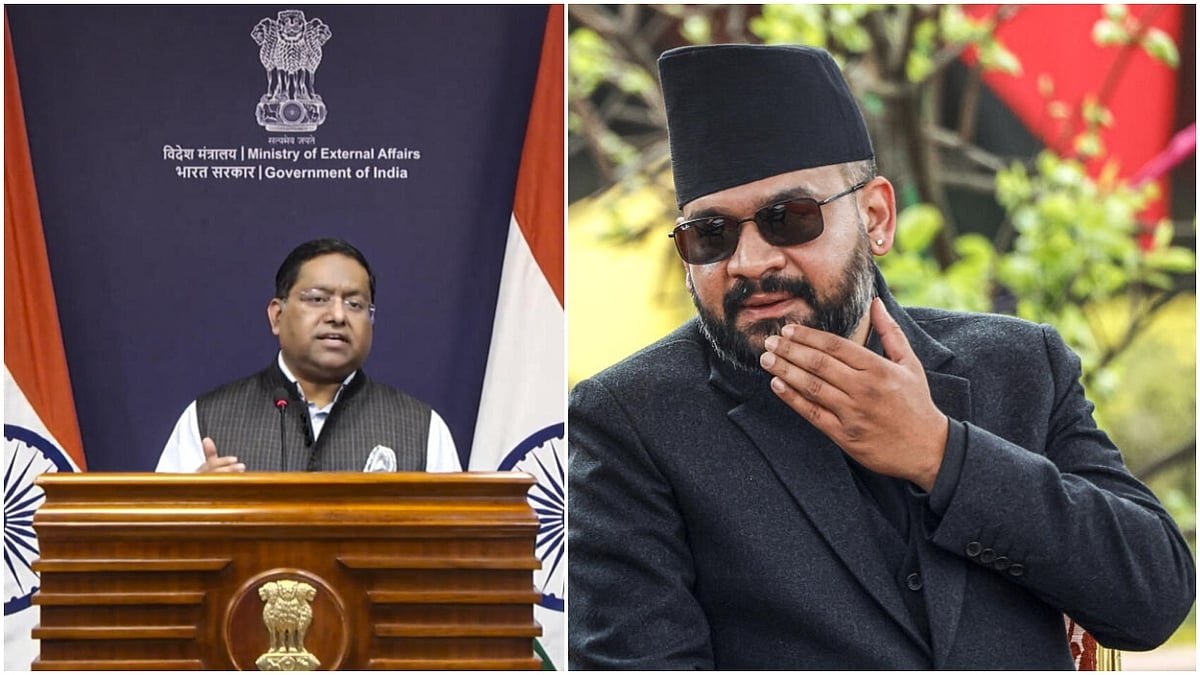
NEW DELHI: India has explicitly ruled out any third-party intervention to resolve its long-standing boundary alignment issues with Nepal. The firm diplomatic stance follows a proposal by Nepalese Prime Minister Balendra Shah suggesting the involvement of China and the United Kingdom to mediate the territorial differences.
The Ministry of External Affairs (MEA) re-emphasized that all border arrangements between the two neighboring states remain strictly within a sovereign bilateral framework.
The Bilateral Framework and Boundary Demarcation
Responding to statements originating from Kathmandu, MEA Spokesperson Randhir Jaiswal outlined the current progress of the border mapping and the existing protocols established between the two nations:
-
Strictly Bilateral: “We have established bilateral mechanisms to deal with all aspects of boundary matters. It should be clear to all concerned that there is no role for any third parties in a bilateral matter between India and Nepal,” Jaiswal stated during a media briefing.
-
High Demarcation Rate: The MEA highlighted that close to 98% of the India-Nepal boundary has already been successfully demarcated.
-
The Remaining Geomorphic Disputes: The minor unresolved segments are primarily a result of the shifting geographical course of the Gandak River. Additionally, joint survey teams are currently mapping instances of cross-border occupation and encroachment on designated No-Man’s land along the already demarcated stretches.
Context of Nepalese Prime Minister’s Remarks
The diplomatic friction escalated after Nepalese Prime Minister Balendra Shah—a rapper-turned-politician—addressed the Nepalese Parliament. Shah argued that because the root of the border dispute traces back to the departure of British India from the subcontinent, London should be brought into the discussions alongside Beijing. The core dispute centers around the strategic Lipulekh, Limpiyadhura, and Kalapani regions situated near the India-China border, which India maintains are integral territories of Uttarakhand.
Shah also sparked domestic political backlash by stating in parliament that territorial encroachment had occurred from both sides, acknowledging that Nepal had also “encroached” on Indian territories.
Following immediate protests from Nepalese opposition lawmakers—who demanded the remarks be expunged unless backed by concrete proof—the Nepal Foreign Ministry issued a clarification. The ministry stated that the Prime Minister’s comments pertained strictly to localized “no-man’s land encroachments” rather than formal state-level territorial counterclaims.
Standing Rejection of “Artificial Enlargements”
This diplomatic exchange follows a similar friction point in May 2026, when New Delhi dismissed Kathmandu’s formal objections regarding the annual Kailash Mansarovar Yatra routed through the Lipulekh Pass. At the time, India categorized Nepal’s expansive mapping adjustments as an “unilateral artificial enlargement” that lacks any backing of historical facts or verified geographic evidence.