



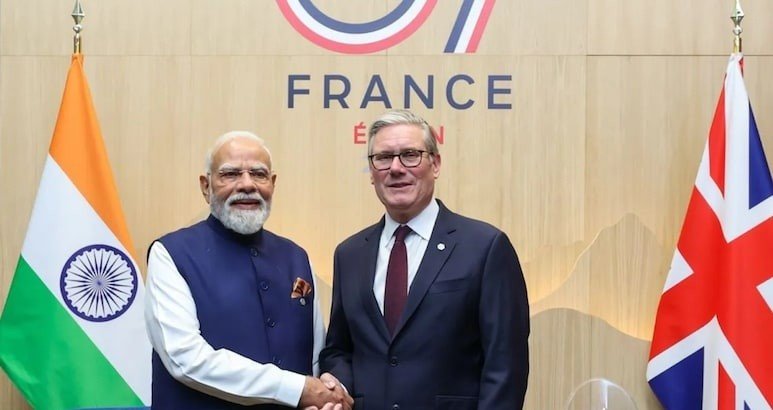
ÉVIAN-LES-BAINS (FRANCE) — Elevating the scope of the India–United Kingdom Comprehensive Strategic Partnership, Prime Minister Narendra Modi and British Prime Minister Keir Starmer held extensive bilateral talks on the sidelines of the G7 Summit. The dialogue focused heavily on accelerated economic integration, defense alignment, and a mutual commitment to finalize the landmark Comprehensive Economic and Trade Agreement (CETA).
The high-level session builds directly on momentum generated by reciprocal state visits last year, driving forward the bilateral Vision 2035 framework.
CETA Progress and UK University Campuses in India
A primary driver of the talks was the institutional push to unlock multi-sector trade pathways and boost cross-border human capital:
-
The Free Trade Mandate: Both leaders reviewed the fine print of CETA, expressing optimism for an early entry into force. The pact is structured to eliminate market access barriers across manufacturing, high-tech services, and green industries to significantly build upon existing record bilateral trade volumes.
-
Transnational Higher Education: Marking a structural milestone under India’s liberalized education frameworks, the leaders welcomed the physical expansion of premier British academic institutions into Indian tech hubs.
-
Campus Updates: The University of Liverpool is actively setting up its campus in Bengaluru, while the University of York and the University of Bristol are advancing concrete plans to establish operational bases in Mumbai.
Tech Security Initiative and Critical Mineral Supply Chains
Reflecting a major shift toward high-tech defense and supply chain insulation, the leaders evaluated progress under the joint Technology Security Initiative:
-
AI Collaboration: PM Modi extended formal appreciation to the UK administration for its extensive ministerial participation in the New Delhi AI Impact Summit held earlier this year.
-
The Global Supply Chain Observatory: The PMs lauded the formal operationalization of the India-UK Critical Minerals Global Supply Chain Observatory. This strategic mechanism is designed to map and secure resilient corridors for rare earth elements and critical minerals, systematically reducing vulnerabilities to global supply shocks.
-
Defense Coordination: The leaders reinforced joint military R&D protocols and maritime security cooperation to address shifting geopolitical realities across the Indo-Pacific and Euro-Atlantic zones.
Geopolitical Alignment on Global Conflicts
Beyond economic and academic ties, the two heads of government exchanged strategic perspectives on volatile international hot zones:
“The discussions reflected a growing convergence between New Delhi and London on navigating global economic and security uncertainties through a rules-based international order.” — Ministry of External Affairs (MEA)
The leaders compared notes on the evolving diplomatic landscape in West Asia following recent de-escalation milestones, as well as the protracted conflict in Ukraine, underlining the shared responsibility of two of the world’s leading democracies to support international peace and maritime freedom.