



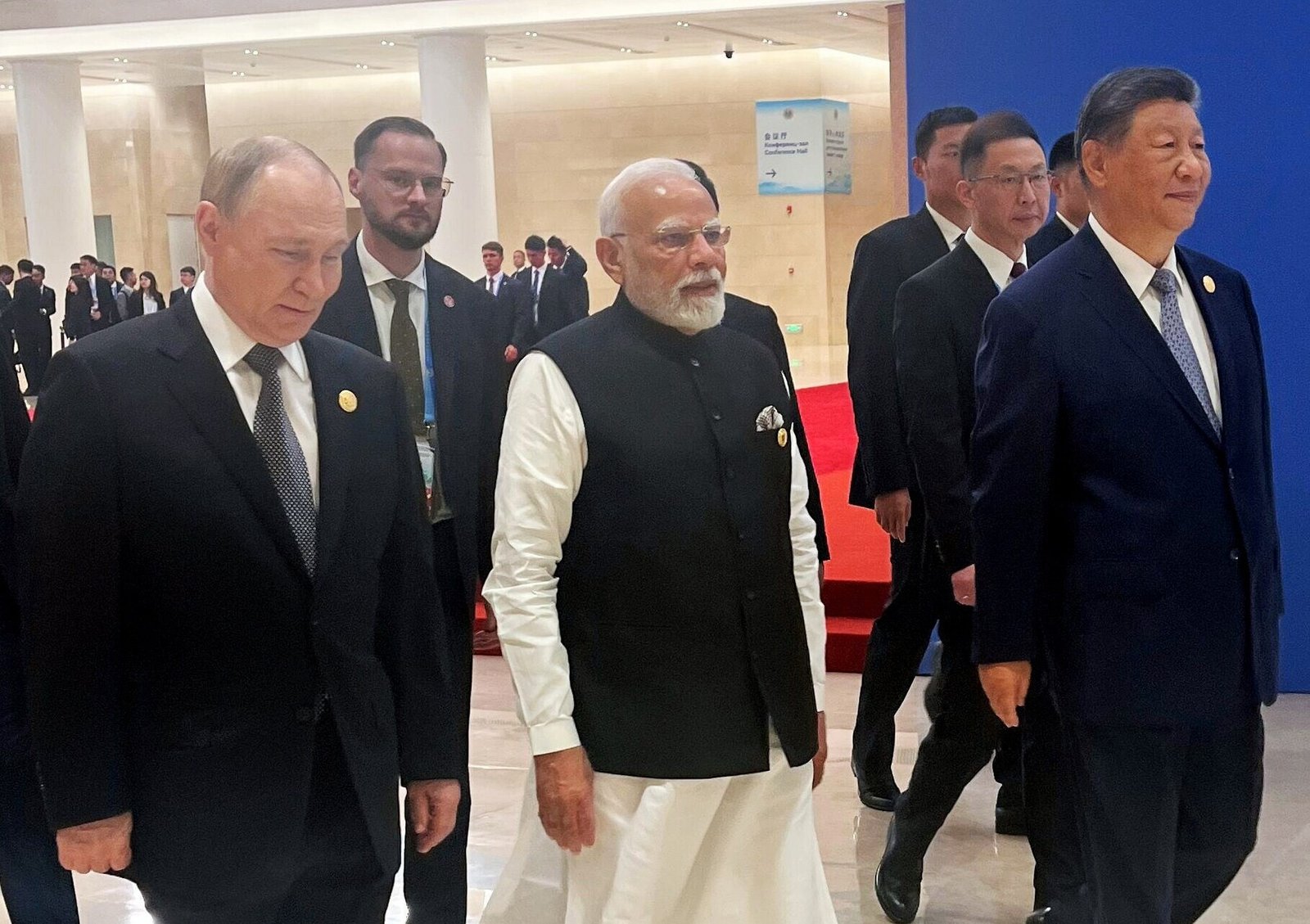
BISHKEK — The latest Shanghai Cooperation Organisation (SCO) summit in Bishkek offered a textbook snapshot of the diplomatic tightrope India has walked for years: maintaining active engagement with Moscow, Beijing, and Central Asian capitals without allowing itself to be boxed into any single geopolitical camp.
Since acquiring full membership in 2017 alongside Pakistan, New Delhi has mastered the art of turning a China-dominated bloc into a functional platform for its own national interests. For India, the SCO serves as an indispensable bridge to resource-rich Central Asia, a direct channel to engage Beijing and Moscow, and a global pulpit to press its zero-tolerance stance on cross-border terrorism.
1. The Xi Moment: Managed Friction, No Breakthrough
All eyes were fixed on the interaction between Prime Minister Narendra Modi and Chinese President Xi Jinping. What transpired was a brief, highly choreographed exchange—a shared walk, greetings, and a post-photo conversation, but no formal bilateral meeting.
-
Strategic Trust Deficit: Relations remain fragile following the 2020 military standoff along the Line of Actual Control (LAC). While tactical border disengagements have taken place, structural trust remains low.
-
Diplomatic Continuity: The primary objective in Bishkek was simply preventing dialogue from turning cold ahead of the upcoming BRICS summit in New Delhi, where both leaders are scheduled to meet again.
2. A Sharper Message Delivered Across the Table
Modi delivered a blistering critique of selective counterterrorism, pointing out that global forums cannot condemn violence in one breath while ignoring state-sponsored terror in the next—a message delivered directly across the table from Pakistan’s leadership.
This persistent framing aligns directly with the security anxieties of Central Asian republics, who remain hyper-focused on radicalisation and regional fallout stemming from Afghanistan.
3. Russia: Strategic Realities Behind the Surging Trade Deficit
While the exchange with Xi was about managing friction, the sit-down with Russian President Vladimir Putin centered on managing a deep historic partnership complicated by modern trade distortions.
| Indicator / Domain | Status & Metrics | Strategic Implication |
| Bilateral Trade (2021) | ~$13 Billion | Baseline pre-war economic engagement. |
| Bilateral Trade (2025) | ~$60 Billion | Energy-driven surge via discounted Russian crude. |
| Trade Deficit | >$50 Billion (in Moscow’s favour) | Critical Risk: India demands wider market access in meat, dairy, and seafood. |
| 2030 Trade Target | $100 Billion | Unachievable without structural economic rebalancing. |
| Defense & Geopolitics | Core Partnership | War in Ukraine strains India’s balancing act with Washington and Europe. |
During the talks, Prime Minister Modi renewed India’s long-standing call for a negotiated resolution to the conflict in Ukraine, stressing that disruption to Black Sea and West Asian shipping lanes directly threatens global energy supplies and maritime trade.
4. The Long Game: Soft Power and Central Asian Connectivity
Beyond the big-power diplomacy lies India’s primary objective: expanding its footprint across Central Asia to offset land access limitations caused by Pakistan and balance China’s heavy infrastructure investments.
-
Energy & Trade Corridors: Securing critical raw materials and uranium supply chains—underscored by Modi’s strategic stopover in Uzbekistan prior to the summit.
-
Institutional Expansion: Pushing economic development initiatives through startup hubs, young scientist exchanges, and the newly announced SCO Civilisational Dialogue Forum.
-
Soft Power Outreach: Cultural engagement highlighted by India’s 87-member contingent at the World Nomad Games in Bishkek.
The Road Ahead
Bishkek did not resolve the border standoff with China or erase the massive trade imbalance with Russia, but resolving complex geopolitical realities in a single weekend was never the objective. The summit proved that India remains comfortable operating at the center of competing global interests—keeping China talking, keeping Russia close, holding Pakistan accountable, and carving out its own space in Central Asia.
With New Delhi preparing to host global leaders at the upcoming BRICS summit, India’s strategic maneuvering will soon face an even bigger test on home turf.