



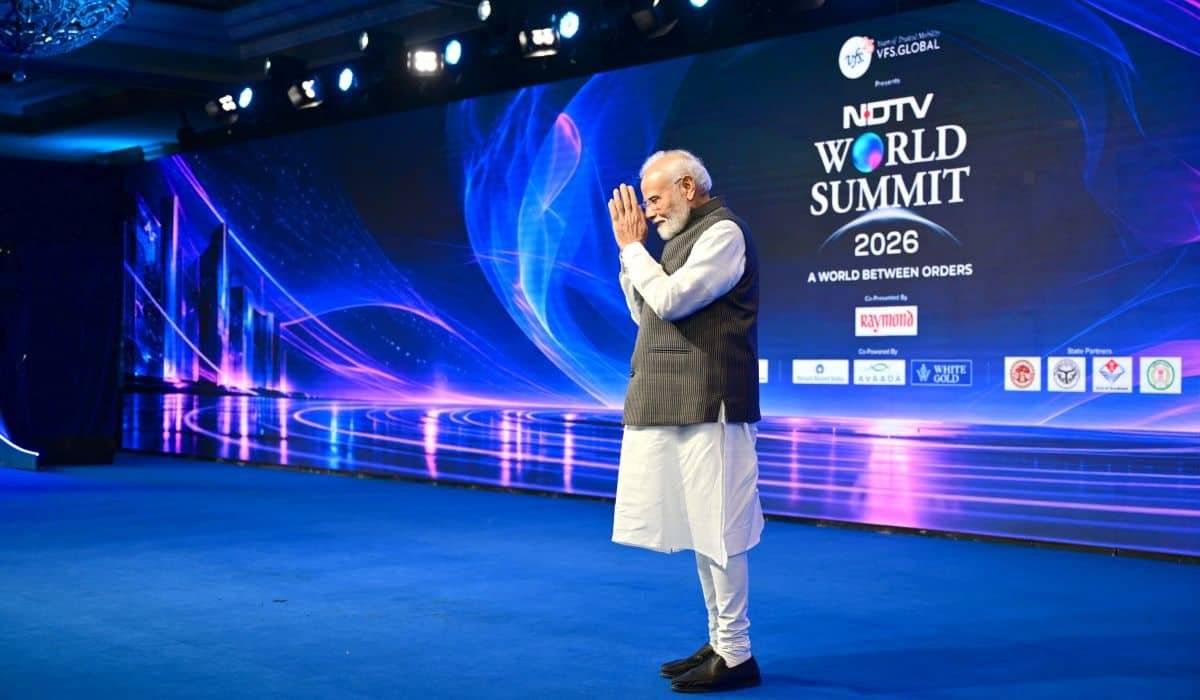
NEW DELHI — National and global leaders convened in the capital for a major two-day policy summit examining global governance, systemic financial oversight, and domestic policy priorities. Key deliberations centered on Prime Minister Narendra Modi’s call for structural reform within multilateral institutions and Reserve Bank of India (RBI) Governor Sanjay Malhotra’s reaffirmation of statutory listing rules for large corporate holding entities.
Key Takeaways
-
Multilateral Governance Reform: Prime Minister Narendra Modi cautioned that international institutions are falling behind global realities, warning that critical trade corridors, technological networks, and maritime routes are increasingly subject to strategic coercion.
-
Non-Negotiable Listing Directives: RBI Governor Sanjay Malhotra confirmed that Core Investment Companies (CICs) operating within the central bank’s upper-layer financial category must execute public stock exchange listings if they maintain direct or indirect public capital exposure.
-
Capital Exposure Exemptions: The central bank clarified that holding companies seeking exemption from mandatory listing provisions must formally restructure their financial architecture to fully decouple from public funds, corporate bonds, and commercial bank leverage.
-
Political Economy Perspectives: Keynote addresses highlighted the intersection of political stability and economic development, stressing the need for predictable governance structures.
Global Institutional Vulnerabilities and Trade Stability
Addressing the assembly during the opening sessions, Prime Minister Narendra Modi emphasized that shifting geopolitical dynamics are placing unprecedented strain on international governance frameworks.
Underscoring the risks of regulatory paralysis and unmonitored power imbalances in international relations, Modi pointed to ancient strategic principles regarding systemic order:
“When the law of punishment is kept in abeyance, it gives rise to Matsya Nyaya (the law of the sea), meaning the strong shall swallow the weak.”
The Prime Minister warned that international supply chains, technological infrastructure, and strategic sea lanes are increasingly vulnerable to unilateral disruption, calling for comprehensive updates to global treaties and international bodies to preserve economic stability.
Central Bank Policy on Systemic Financial Regulation
Discussions on macro-financial regulation dominated subsequent proceedings as RBI Governor Sanjay Malhotra addressed the regulatory standards governing large conglomerate holding structures and systemic investment bodies.
Outlining the risk-management rationale governing Non-Banking Financial Companies (NBFCs) and Core Investment Companies, Malhotra emphasized the central bank’s focus on protecting public capital:
“Non-banking financial companies (NBFCs) and core investment companies… are required to be registered with the RBI because of the systemic risks, as they sit on top of group companies, can leverage funds, and use the balance sheets of those companies. The funds of the public, whether through banks, corporate bonds, or other means, are at risk when CICs do this.”
Malhotra delineated the statutory compliance avenues available to regulated entities under central bank oversight:
-
Complete Financial Decoupling: A holding company or Core Investment Company can avoid mandatory registration and exchange listing requirements only if it undergoes structural reorganisation to completely eliminate all reliance on public funds, institutional debt, and bank credit lines.
-
Mandatory Public Listing: Any upper-layer financial entity that maintains access to public capital—either directly or through group balance sheets—remains legally bound to execute a public stock exchange listing to ensure systemic transparency and operational compliance.